

ADHD in Midlife: Why So Many Smart Women Are Misdiagnosed
Podcast · Energized with Dr. Mariza · Episode 674
Hosted by Dr. Mariza Snyder · Guest: Shanna Pearson · · 41 min watch
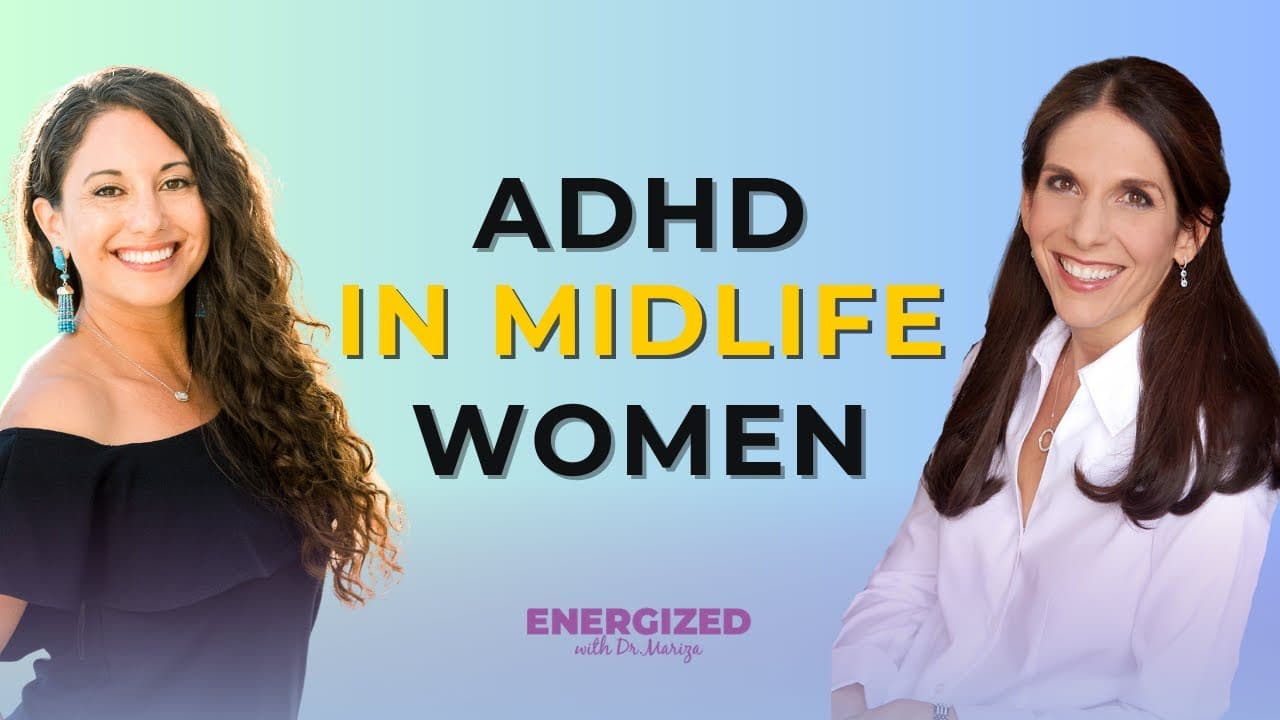
On episode 674 of Energized with Dr. Mariza, Dr. Mariza Snyder talks with Shanna Pearson, founder of Expert ADHD Coaching and author of Invisible ADHD, about why women with ADHD are so often diagnosed with anxiety or depression instead, why symptoms can surface in midlife, and where to start once you know.
In this episode
- Why the GAD-7 and PHQ-9 questionnaires that doctors hand out lead so many women with ADHD to a diagnosis of anxiety or depression, with Shanna holding up the forms
- Two signs to look for: a hard time staying present, and overwhelm so constant it leaves you frozen
- Seasons of chaos, like the pandemic years, and why the tools help whether or not you have a diagnosis
- Holding firm boundaries around family while work flexes
- How falling estrogen affects dopamine, so strategies that worked for years stop working
- Finding an ADHD specialist for a full assessment that looks back over your life, and the first tool to try: “Keep it to three, and you’re free”
Episode links
- The episode page on drmariza.com, with show notes and quotes, titled “Invisible ADHD: The Real Reason So Many Smart Women Are Misdiagnosed And How to Finally Get Answers”
- The video on YouTube, titled “Invisible ADHD in Women: Why You Might Be Misdiagnosed”
- Apple Podcasts and Spotify
Transcript
This transcript follows the video above. Times are minutes and seconds into it. The audio episode is a different, longer edit, so its times differ.
Dr. Mariza Snyder (0:00): (upbeat music) Welcome to the Energize Podcast. Shanna, honey, how are you doing today, girl?
Shanna Pearson (0:08): I am doing amazing today, like, really good. Good energy, and I can tell you're exactly the same. (chuckles)
Dr. Mariza Snyder (0:14): And I love that we are literally 15 minutes away from each other.
Shanna Pearson (0:18): I know.
Dr. Mariza Snyder (0:18): You are in Del Mar. I am in Encinitas. We're like sisters in different little beach towns in San Diego, California, so-
Shanna Pearson (0:26): It's-
Dr. Mariza Snyder (0:26): ... so happy to be here
Shanna Pearson (0:26): Isn't that crazy? And our kids are at the exact same place right now, at the same camp, which is-
Dr. Mariza Snyder (0:31): Oh, my goodness
Shanna Pearson (0:31): ... a lot
Dr. Mariza Snyder (0:32): I love that.
Shanna Pearson (0:32): Yeah.
Dr. Mariza Snyder (0:32): I just love... Yeah, your daughter, she is volunteering. My son is actually participating at this beautiful farm camp called-
Shanna Pearson (0:39): Yeah
Dr. Mariza Snyder (0:39): ... Coastal Roots, where they are learning how to not only be one with nature, but how to cultivate the nourishing food that-
Shanna Pearson (0:46): Mm
Dr. Mariza Snyder (0:46): ... feeds and supports our body, which is so, so beautiful.
Shanna Pearson (0:48): It's beautiful.
Dr. Mariza Snyder (0:49): Yeah.
Shanna Pearson (0:50): Yeah. (chuckles)
Dr. Mariza Snyder (0:50): Well, we're talking about your book, Invisible ADHD, particularly how it's impacting women. I would say that is very much the invisible conversation because-
Shanna Pearson (1:01): Yeah
Dr. Mariza Snyder (1:01): ... a lot of us think of ADHD just like we think of heart disease. We think it's men.
Shanna Pearson (1:06): Yeah.
Dr. Mariza Snyder (1:06): Men, men, men, men, men.
Shanna Pearson (1:07): Right.
Dr. Mariza Snyder (1:07): It, yeah, it's not happening to us as women. So tell me about kind of the defining moment for you, where you were like, "This needs to get out there. This is the message I'm here to spread. I want to change the narrative on how we take care of women and their mental health."
Shanna Pearson (1:22): The moment happened (chuckles) when... W- it wasn't... The moment happened when I realized I needed to start the coaching company that I started because that was an aha moment, where I learned there are definitely things that we need to do differently, and as a person with ADHD, let alone a woman with ADHD. And so, you know, that's the light bulb moment, where I'm like, "I need to get this out. I need to help people. I need to teach them." Obviously, once I figured out how to do it (chuckles) myself, because, you know, I was, like, the prime candidate to be a client, but it's very mission-driven, you know? And so the book was out- they c- the publishers came to me and asked. I did not set out writing a book and try to sell it to a publisher because that wasn't my thing. I'm running a company. I'm trying to help as many adults with ADHD as possible, but they came to me and asked if I would write a book for women, which I thought, "Huh?" (chuckles) You know-
Dr. Mariza Snyder (2:16): I love that
Shanna Pearson (2:18): ... just, we have just as many-
Dr. Mariza Snyder (2:19): Wow, I love that.
Shanna Pearson (2:19): We have just as many men as women clients, and everyone in between, and it doesn't... Like, why just women? And then I thought about it. Like, I didn't answer right away. I'm like: Do I want to write a book just for women? And it's just like, I don't know, I guess within a few days, I realized, like, it's like this waterfall of information, and how ADHD specifically affects us, and how many women, most importantly, don't even know we're living with it.
Dr. Mariza Snyder (2:45): Yeah.
Shanna Pearson (2:45): We have no idea, and so that was the moment I was like, "I just want people who have ADHD to know that they have ADHD, so that they can get along with their life and start managing it, and just have a good life versus, like, a very tumultuous, stressful life."
Dr. Mariza Snyder (3:01): Mm. You know, I always say that I take care of everybody, or I serve everyone by serving women, so I am not surprised. (chuckles)
Shanna Pearson (3:09): That's so good. (chuckles) Yeah.
Dr. Mariza Snyder (3:11): That this book is focused and geared towards women because when women are thriving, when their mental health and their emotional resilience is on point, it impacts their families, it impacts community, it changes the world.
Shanna Pearson (3:25): Yeah, there you go.
Dr. Mariza Snyder (3:26): So that's-
Shanna Pearson (3:26): Awesome
Dr. Mariza Snyder (3:26): ... where I'm at with it.
Shanna Pearson (3:27): Yeah.
Dr. Mariza Snyder (3:27): That's my through line. (chuckles)
Shanna Pearson (3:28): So think about it.
Dr. Mariza Snyder (3:29): I am not surprised that they came to you, and they're like, "So listen, we're gonna need a book on ADHD for women," because-
Shanna Pearson (3:35): It-
Dr. Mariza Snyder (3:35): ... it is really the invisible... And not to say that men... My, my husband, and he'll tell you, full transparency, and I'm allowed to share, but he has ADHD. And-
Shanna Pearson (3:43): Okay, yeah.
Dr. Mariza Snyder (3:44): And so, again, I think we always, we often think that it's more geared towards men, but I think the reason for that is that it's just the attention and the clinical research, and kind of the knowledge base is really based around that particular demographic. And we just have ignored women and mental health challenges, and yet more women than men will experience clinical depression and anxiety.
Shanna Pearson (4:05): Mm.
Dr. Mariza Snyder (4:05): And again, I don't think we have the stats for ADHD, 'cause we just don't have them. But when we look at some of the other mental health issues and concerns, women do have... They- I mean, the numbers are bigger for us, especially in the, I call it the zone of chaos, the perimenopause transition, where it all just seems to come up for review.
Shanna Pearson (4:23): Right.
Dr. Mariza Snyder (4:23): So I'm curious, you know, for women-
Shanna Pearson (4:24): There's a lot I want to say about what you're talking about-
Dr. Mariza Snyder (4:26): Yes, please
Shanna Pearson (4:26): ... in terms of mental health, and diagnosis, and anxiety, and depression, and ADHD. There's so much that women need to know.
Dr. Mariza Snyder (4:34): Yeah.
Shanna Pearson (4:34): There's so much they need to know. If... The reason why so many women are being diagnosed with anxiety is because the symptoms for anxiety overlap with so many other challenges. And so you might, you might have symptoms of anxiety, and therefore, you're gonna be diagnosed with anxiety, but you actually have ADHD.
Dr. Mariza Snyder (4:54): Mm.
Shanna Pearson (4:55): Right? And the symptoms of anxiety and depression also overlap. I can show you... Like, if you go to a doctor right now, today, and you're like: "I'm worried about my future. I don't feel like I'm living up to my potential. Everything is chaotic. I don't know what to do. I feel like I'm terrified to get out of bed in the morning," right? Which is an experience that-
Dr. Mariza Snyder (5:14): Yeah
Shanna Pearson (5:14): ... a lot of women have, especially, like, women tend to feel the need to take care of absolutely everybody, so it's- there's a lot of responsibility.
Dr. Mariza Snyder (5:21): Yes.
Shanna Pearson (5:22): We have a lot of responsibility on our shoulders, and so if you go to a doctor and talk about this, they're gonna give you an assessment for... Can I show you?
Dr. Mariza Snyder (5:29): Yes.
Shanna Pearson (5:29): This is what you're gonna get.
Dr. Mariza Snyder (5:30): Yeah.
Shanna Pearson (5:30): It's called the GAD-7. (chuckles)
Dr. Mariza Snyder (5:32): Mm-hmm.
Shanna Pearson (5:33): And they're gonna give you an assessment, a self-assessment that you have to answer yourself, based on how you feel that day. And so all of these, there's only seven questions, and every single one of them, you know, trouble relaxing-
Dr. Mariza Snyder (5:46): (chuckles)
Shanna Pearson (5:46): ... becoming restless, becoming easily annoyed, which might not be you, but it's definitely a lot of women with ADHD.
Dr. Mariza Snyder (5:52): Number one most common symptom of perimenopause, too, by the way, is-
Shanna Pearson (5:56): Exactly
Dr. Mariza Snyder (5:56): ... becoming easily annoyed and irritable.
Shanna Pearson (5:58): Ex-
Dr. Mariza Snyder (5:58): Yeah.
Shanna Pearson (5:58): 100%. Not being able to stop worrying.
Dr. Mariza Snyder (6:01): ... Ah, yeah. I mean, every woman-
Shanna Pearson (6:03): Like all-
Dr. Mariza Snyder (6:03): Every mom?
Shanna Pearson (6:04): Every single one of these, and so everyone's gonna be- everyone is gonna be diagnosed with anxiety, unless you've gotten really, really good at maintaining calm and creating inner peace. And the same goes for the depression scale. Every single one of these, except for the last one, which is the P- this is the PHQ-9, which is what your doctor will give you as a self-assessment for depression, all of these are overlapping with ADHD. All of them.
Dr. Mariza Snyder (6:26): And mind you, she is showing you... If you guys are on YouTube watching the video, she is showing you the forms. And I have a feeling that as you're listening to this, you have seen or you have filled out these forms-
Shanna Pearson (6:36): Yep, I feel like a lot of us have.
Dr. Mariza Snyder (6:37): One in four of us, one in four women now are on an antidepressant or anxi- anxiety medication.
Shanna Pearson (6:43): How can you not be diagnosed with depression? It's like-
Dr. Mariza Snyder (6:46): It is so general.
Shanna Pearson (6:47): It's like all of these-
Dr. Mariza Snyder (6:48): Yeah
Shanna Pearson (6:48): ... all of these, all of these questions that they ask you in the depression scale, I think are relevant to all of us. You know, feeling down. You're gonna go to your doctor and complain about these things when you're feeling down, not when you're feeling like you're on top of the world. Yeah, fa- trouble falling or staying asleep, this is also- this is for every person with ADHD. This is something that we all have to deal with. Poor appetite or overeating. (chuckles) So it's one or the other. Feeling bad about yourself, tr- trouble concentrating on things. This is all on the depression scales, and women with ADHD and other challenges are gonna be answering, you know, several days, more than half the days. That's why so many of us are misdiagnosed with depression.
(7:34) That is it, because this is- we would all answer on a p- you know, at least half the days to every single one of those, except for the very last question on the depression scale, but that's a big deal. And so a lot of women with ADHD and other challenges, even if it's just hormonal, major hormonal shifts, are being diagnosed or misdiagnosed with depression and anxiety, and then they're being mismedicated. So now you're taking an antidepressant or an anti-anxiety medication, and you're still not feeling any better, which just makes you feel worse, and so that's- it's a really, really scary cycle.
Dr. Mariza Snyder (8:10): I was gonna say, it feels like it's a scary... It- it's not just scary, but just almost feels h- an hopeless cycle, too-
Shanna Pearson (8:16): Yeah
Dr. Mariza Snyder (8:16): ... in a lot of ways.
Shanna Pearson (8:17): Oh, my gosh!
Dr. Mariza Snyder (8:17): This is not gonna leave me.
Shanna Pearson (8:18): This isn't even working for me.
Dr. Mariza Snyder (8:19): Yeah, exactly.
Shanna Pearson (8:19): Yeah. No, it's terrible. So that's where it, you know, it's sort of like everything just dropped, and I'm like, "I have to write this book. I have to make sure that everyone knows what's going on for them," because you'll love this, the d- (chuckles) the ADHD self-assessment is very much skewed towards male symptoms. So even when a woman (chuckles) does that questionnaire, it's gonna skip over all of the typical female traits.
Dr. Mariza Snyder (8:45): Hmm. I'm not surprised. I'm never surprised, unfortunately.
Shanna Pearson (8:48): I know, I-
Dr. Mariza Snyder (8:48): But I'm always just disappointed.
Shanna Pearson (8:50): Disappointed.
Dr. Mariza Snyder (8:51): Yeah.
Shanna Pearson (8:51): It is disappointing, and I think we need to make a lot of noise about this because it's kind of ridiculous in a way that where we are right now in the world, and as advanced as we are, and we're still, (chuckles) we're still, like, completely getting it wrong in these diagnostics.
Dr. Mariza Snyder (9:06): Curious... You know, I always think about a lot of these symptoms, particularly when it comes to mental health, are so subjective for women, even like we're looking at kind of these questionnaires to diagnose.
Shanna Pearson (9:15): You have to answer them yourself.
Dr. Mariza Snyder (9:17): Yes, and so-
Shanna Pearson (9:17): Yeah
Dr. Mariza Snyder (9:18): ... and what we've learned or what kind of the medical system has kind of put women in a box of, if it's, you know, it's a subjective symptom, "She's just a complainer. It's all in her head," like it's not real, or, "She's just stressed," or-
Shanna Pearson (9:30): "It must be that time of the month."
Dr. Mariza Snyder (9:31): Yeah, yeah, must... All the things, right?
Shanna Pearson (9:32): Mm-hmm.
Dr. Mariza Snyder (9:33): So it's a big brush-off.
Shanna Pearson (9:34): Yeah.
Dr. Mariza Snyder (9:35): So talk to me about how women can... And then leading to misdiagnosis and mismanagement of treatment or no treatment at all, told to relax or, you know-
Shanna Pearson (9:44): Yeah
Dr. Mariza Snyder (9:45): ... work out more, or whatever, whatever it be-
Shanna Pearson (9:47): Go take a warm bath.
Dr. Mariza Snyder (9:48): (chuckles) ... attitudes are, right? Exactly.
Shanna Pearson (9:50): Yeah.
Dr. Mariza Snyder (9:50): How do we advocate? I have a big part of this book is probably trying to gain agency and really get the care that we deserve. What are some of the ways that we can navigate this?
Shanna Pearson (10:00): I feel like a, a lot of what this book is, is just giving people the correct information based on what we know, based on, you know, tens of thousands of clients. And it's like, I can just tell you, "This is what's going on. This is how you'll know. Please go to a specialist and find out what's going on for you." I don't want it to get like, you know, we have to like, make a political statement. I want women to be okay. I want women to know what's happening for them, and I want them to be able to have access to the tools that are gonna make their life a billion times easier.
Dr. Mariza Snyder (10:31): Well, I wanna get into the nitty-gritty, you know-
Shanna Pearson (10:34): Yeah
Dr. Mariza Snyder (10:34): ... 'cause I get, um, the lis- I know women are listening right now. I know someone's listening and thinking, "Gosh, is this ADHD? Have I been misdiagnosed? Like, I don't know what's going on with me."
Shanna Pearson (10:42): Yeah.
Dr. Mariza Snyder (10:42): "Something just doesn't feel right."
Shanna Pearson (10:44): Right.
Dr. Mariza Snyder (10:44): So how- what are some of the clues that we might have ADHD, even i- whether we've been diagnosed with something else or, you know, or we're taking some medication, or how would we know?
Shanna Pearson (10:55): There's a couple of telltale signs, and one of them would be a very, very, very (chuckles) difficult... B- it's very difficult to stay present, period. Whether you're male or female or whatever you identify as, you have a hard time being present. So for, you know, in general, in general, and I need to be, like, really specific about that, men tend to be a little bit all over the place physically. They'll be, like, fidgeting, or you'll be sitting at a table with them, and their eyes will be, like, all over the pl- like, they just won't be looking at you. It's really hard for them to make eye contact. It's hard for them to just... It's hard for them to be attentive. They're doing different things.
(11:36) For women, a lot of that is internal, so they could be sitting there staring right at you and thinking about something completely (chuckles) different than what you're talking about, and, you know, th- it's more about an internal hyperactivity versus an external hyperactivity. So if you find that you're always, you know, or not... I don't want to say always, but, like, 80% of the time, you have to be very conscious of paying attention and being present, regardless of whether you're at home with your family, at work, with your f- whatever the situation is, 'cause it's in different situations, if it's hard for you to be present, that's a sign.... and another one is that, and this is not on the assessment tools, but this is for, I would say, 95% of all women with ADHD live in perpetual overwhelm.
Dr. Mariza Snyder (12:26): Mm.
Shanna Pearson (12:26): Where it's so intense, because you have so many things from so many different categories all in your mind at the exact same time, and you have an inability to, like, compartmentalize what goes where, and what you need to do, and how to start on anything, that, you know, I call it... It's like a deer-in-headlights syndrome, where you're kind of frozen, and you feel like that-
Dr. Mariza Snyder (12:48): Like a fight, flight, freeze kind of response? Would you- I mean, is it similar-
Shanna Pearson (12:52): I would say... I don't know about the flight. I would just be, well, freeze.
Dr. Mariza Snyder (12:55): Freeze.
Shanna Pearson (12:55): A freeze response, really.
Dr. Mariza Snyder (12:56): But more like a sympathetic dominance? You know, like, could we get caught in that on a-
Shanna Pearson (13:00): You get caught, you're frozen, you're paralyzed.
Dr. Mariza Snyder (13:03): Yeah.
Shanna Pearson (13:03): You end up, ah, you know, quote-unquote, "self-medicating" with Netflix or whatever else is easiest to focus on and to take your mind off of it. But it's almost like that feeling of, "I just can't deal. I don't know what to do." That feeling, if that's occurring for you often, and it's been occurring for you for most of your life, that's a very, very strong sign.
Dr. Mariza Snyder (13:28): Mm.
Shanna Pearson (13:29): Because that's ADHD.
Dr. Mariza Snyder (13:30): Ooh, I have some follow-up questions.
Shanna Pearson (13:32): Yeah.
Dr. Mariza Snyder (13:33): One, I feel like women have been trained, particularly moms, to juggle all of it all the time, so-
Shanna Pearson (13:38): Yes
Dr. Mariza Snyder (13:38): ... lots of high-level multitasking.
Shanna Pearson (13:40): Totally.
Dr. Mariza Snyder (13:40): And so I think when you're even starting with someone, you are running through a multitude of lists. Because let's be honest, the list is insane. Like, you're like, "Okay, did I call the dentist? Wait, did I get those shoes? Did I do the thing? Oh, my God, he's starting school next week. Did I even order that lunchbox?" Like, you know, just running through, "Okay, what time do I gotta pick him up?" Like, reverse engineering, da, da, da. Like, you know, that, I feel like women are constantly... If anything, I was always told that that was a superpower, you know? And so I'm curious if we've been trained to be like this, if epigenetically, this is how we operate. Because... And then I also think about women who, with the amount of to-do lists, managing the household, the career, the company, the children, all of those things, and that there's so much spill-over, you know, into...
(14:22) So you're like, "Oh, my gosh," like, "I'm- I just freeze." I will say, you and I are both in a book launch, and I always joke that my head's on a swivel right now. I'm like, "Wait, where am I going, and who am I?-
Shanna Pearson (14:32): Right!
Dr. Mariza Snyder (14:32): "What country?-"
Shanna Pearson (14:33): What country am I in?
Dr. Mariza Snyder (14:33): But yeah, what country (chuckles)
Shanna Pearson (14:34): What time is it? (chuckles)
Dr. Mariza Snyder (14:35): Where- what time zone? Yeah, like, I'm checking time zones-
Shanna Pearson (14:37): (gasps)
Dr. Mariza Snyder (14:38): ... and my schedule keeps shifting, 'cause my team keeps moving things.
Shanna Pearson (14:41): Yeah.
Dr. Mariza Snyder (14:42): And I'm like, "Ah, where am I supposed to be?" And so I do find myself... As of recent, I was- a confession to one of my best friends, is like, I've been on social media more, because my brain is trying to tune out, and this is not typically how I operate.
Shanna Pearson (14:53): Right.
Dr. Mariza Snyder (14:54): I'm usually not doing that. But I feel like in this season... Like, my friends are like, "You're in a season, you're in a season." I'm like, "Yeah, but I feel like these are not habits that I wanna pick up any season." Curious if when we're in these types of seasons, that you see more of a presentation of ADHD. Can it-
Shanna Pearson (15:10): Oh, my goodness, that's the whole- that's the whole thing. What you just described is exactly what's going on, and it's what's been going on. You know, when we were in the middle of shelter-in-place orders (chuckles) during COVID, we got- so many people were like, "I have ADHD. Like, I just cannot deal. I can't get anything done. My kids are running around, my spouse is running around the house, and I'm supposed to be getting on all of these Zooms for, for my work," and it's like this very, very hectic time, right? Or, you know-
Dr. Mariza Snyder (15:37): Yeah
Shanna Pearson (15:37): ... you could call it, those two years, a very long season, (chuckles) right?
Dr. Mariza Snyder (15:40): Yeah. No, it was a season of chaos-
Shanna Pearson (15:42): Right?
Dr. Mariza Snyder (15:43): ... for so many moms and women-
Shanna Pearson (15:44): It was-
Dr. Mariza Snyder (15:44): ... who had to leave the workforce just to manage.
Shanna Pearson (15:47): Just to manage.
Dr. Mariza Snyder (15:48): Yeah.
Shanna Pearson (15:48): Just j- because their kids couldn't be in school.
Dr. Mariza Snyder (15:51): Yeah.
Shanna Pearson (15:51): It was-
Dr. Mariza Snyder (15:51): It was complete chaos
Shanna Pearson (15:53): ... Yeah. And so during these seasons, it doesn't mean that you have ADHD, right?
Dr. Mariza Snyder (15:59): Mm.
Shanna Pearson (15:59): You have the symptoms, so the beautiful... I think the beautiful thing about having tools (chuckles) to manage ADHD, is that regardless of whether you've had a diagnosis or not, the skills will absolutely help you when you're in a season of extreme chaos and overwhelm. So it's like- it's, I would say, probably 20%, I don't know exactly, but we have a lot of clients in our company who have never been diagnosed.
Dr. Mariza Snyder (16:28): I bet. Oh, I bet.
Shanna Pearson (16:29): So just-
Dr. Mariza Snyder (16:30): I, I, I would just assume that number was even higher-
Shanna Pearson (16:32): Yeah
Dr. Mariza Snyder (16:33): ... who just, who are just like, "Something isn't right."
Shanna Pearson (16:35): "Something's not right."
Dr. Mariza Snyder (16:35): Yeah.
Shanna Pearson (16:35): "I just feel like I just can't hold it all together. I feel like I'm running around at a billion miles an hour, and I'm not getting anywhere. What is going on with me?" And we'll- you know, we will obviously help those people, regardless of whether they have ADHD or not. So if you're in any kind of season of chaos, and it's extreme overwhelm, like what you're in right now with the book launch, what we're both in right now, it's essential to keep boundaries in place-
Dr. Mariza Snyder (17:01): Mm
Shanna Pearson (17:01): ... and management-
Dr. Mariza Snyder (17:02): Oh
Shanna Pearson (17:02): ... systems.
Dr. Mariza Snyder (17:03): Shanna, what boundaries?
Shanna Pearson (17:05): Like-
Dr. Mariza Snyder (17:05): I feel like there's... I'm like, what bo- I'm so... And I feel like, peri, too, in midlife, it's like boundary central. Like, if you didn't have any, now is the time. All the boundaries are... I mean, I'm definitely holding boundaries for, like, family and personal.
Shanna Pearson (17:16): That's huge.
Dr. Mariza Snyder (17:16): Uh, but in the b-
Shanna Pearson (17:17): But that's huge.
Dr. Mariza Snyder (17:17): Excuse me.
Shanna Pearson (17:17): Don't discount that.
Dr. Mariza Snyder (17:19): Okay, okay. Good. And but the business, I'm just like, "You know what?" Like-
Shanna Pearson (17:23): That's 'cause it's lower
Dr. Mariza Snyder (17:24): ... I surrender.
Shanna Pearson (17:24): It's fine. But you look at what you just said, and I think it's really awesome, and if everyone, like, really hones in on that. "I'm just holding boundaries for my family."
Dr. Mariza Snyder (17:33): Mm, mm, mm.
Shanna Pearson (17:35): Like, oh, my gosh-
Dr. Mariza Snyder (17:36): I think that's a big one.
Shanna Pearson (17:36): Are you kidding me?
Dr. Mariza Snyder (17:37): Yeah.
Shanna Pearson (17:37): You're holding the boundaries for, like, what is most important, period, end of story. And then what's lower on your... on what p- might be, you know, a lower, like, you know, heart-centered priority, is work, you know, for you, and that's amazing. And so you're not as conscientious of that, but you are when it comes to what's your number one, and that's incredible.
Dr. Mariza Snyder (17:58): Mm.
Shanna Pearson (17:58): So kudos.
Dr. Mariza Snyder (18:00): Thank you. Aw.
Shanna Pearson (18:00): And don't discount it.
Dr. Mariza Snyder (18:02): ... Oh, thank, thank you. Thank you.
Shanna Pearson (18:03): Yeah, 'cause it's okay to be on a swivel if you're not, like, completely tied to it. I would never be... Like what you were saying, like, "Well, where do I go? What do I do?" You probably wouldn't be like that if it had to do with your child.
Dr. Mariza Snyder (18:13): No, absolutely. Yeah-
Shanna Pearson (18:15): See?
Dr. Mariza Snyder (18:15): ... no, non- non-negotiables.
Shanna Pearson (18:16): Non-
Dr. Mariza Snyder (18:16): I know negotiable. For me, and I don't know if you, if this is what you teach a lot, but I'm really big into being in alignment with my values.
Shanna Pearson (18:24): Yeah, same.
Dr. Mariza Snyder (18:25): So.
Shanna Pearson (18:25): That's everything. And so I feel like we're very similar in that way. You know, where like when it comes to the book launch, or when it comes to my business, I'm totally fine with just, like, going with the flow and just, like, doing whatever needs to get done, and the boundaries are kind of... You know, they come, and they go. But with my family, they don't move. They're just- they're stable. There's, like, a very thick line that I, I have to be very conscientious about because it's not natural for my brain to create thick lines. So I block times (chuckles) and I make sure I'm doing XYZ, no matter what, no matter what's going on in my business world.
Dr. Mariza Snyder (19:04): Mm, I love that. Yeah-
Shanna Pearson (19:05): Yeah
Dr. Mariza Snyder (19:05): ... because I know you're a mama, too, and you've got- they're getting a little bit older, but still, having boundaries to, like, after school and spending time-
Shanna Pearson (19:12): Oh, my gosh-
Dr. Mariza Snyder (19:13): Yeah
Shanna Pearson (19:13): ... the older they get, the crazier it gets. I can't believe it. I didn't think that that was it. I thought it was craziest when they were babies. (chuckles) Now, I've got, like, I've got a middle schooler, I've got a high schooler, and it's just, like... And neither one of them drives, obviously, so I'm still the, you know-
Dr. Mariza Snyder (19:26): Yeah
Shanna Pearson (19:26): ... constant Uber driver, and it's just- it's actually beautiful. Thank goodness for driving. (chuckles) Because I-
Dr. Mariza Snyder (19:32): Mm.
Shanna Pearson (19:32): You know? Like, I used to hate it, and I'm like, "This is beautiful. This is good time."
Dr. Mariza Snyder (19:34): You get to spend time with them. Yeah, yeah, I know. I'm gonna... We promised my son we would pick him up early today, so one of us is grabbing- I think I'm gonna be the one grabbing him at, like, 2:30 instead of 3:00, and so... But I really wanna honor his request, and I'm just cutting it all off. You know, I'm cutting everything off at that time today, so I can go-
Shanna Pearson (19:51): Good
Dr. Mariza Snyder (19:51): ... early.
Shanna Pearson (19:52): Good. I have to grab my daughter from the exact same place at the exact same time. (chuckles)
Dr. Mariza Snyder (19:56): Oh, amazing.
Shanna Pearson (19:56): For, for, like, a doctor's appointment.
Dr. Mariza Snyder (19:58): Two kids.
Shanna Pearson (19:58): And I'm like... (chuckles) So we might actually run into each other.
Dr. Mariza Snyder (20:01): That's amazing. I love it.
Shanna Pearson (20:02): That's really cool.
Dr. Mariza Snyder (20:02): I'm holding the vision.
Shanna Pearson (20:04): Yeah.
Dr. Mariza Snyder (20:04): Okay, so one of the things that I was- we were talking about before we jumped on live together-
Shanna Pearson (20:09): (chuckles)
Dr. Mariza Snyder (20:09): ... besides our kids and co-
Shanna Pearson (20:10): This is so funny, though.
Dr. Mariza Snyder (20:11): Oh, my-
Shanna Pearson (20:11): Come on.
Dr. Mariza Snyder (20:12): Yeah.
Shanna Pearson (20:12): I mean... (chuckles)
Dr. Mariza Snyder (20:13): Was one of, one of the phenomena... And I didn't- unfortunately, I- I... Because it, it really isn't my area of expertise as much as some of the other mood changes are, and so grateful to have you on here, because I want to explore this, is that so many women begin to finally realize that they have ADHD in midlife.
Shanna Pearson (20:32): Oh, yeah.
Dr. Mariza Snyder (20:32): But up until that point, had no idea, and still, I'm not saying that all women are even identifying it then, but there's something that happens in midlife where they- like, it's imp- almost impossible to miss at that point, as hormones are declining.
Shanna Pearson (20:45): Mm-hmm.
Dr. Mariza Snyder (20:45): Can you talk a little bit about that, and is this something that you see often in-
Shanna Pearson (20:49): We're seeing it. We- I feel like we're seeing it every single day now.
Dr. Mariza Snyder (20:53): Mm-hmm.
Shanna Pearson (20:53): Thank goodness. Thank goodness, because menopause and perimenopause are having an extremely hot moment (chuckles) this year, and I think for the last couple of years, and I'm so grateful for that, because... I mean, for myself as well, because I'm- you know, that's, like, my age group also. And so it's like, number one, it's pretty simple, okay? So estrogen is lowering. The levels of estrogen that we have are declining. Estrogen is also what regulates dopamine, and so when you have ADHD, it means that you were born with a brain that has less dopamine. Whether it's because we create less or whether it's because less dopamine is able to enter, nobody really knows yet, but we don't have as much dopamine, and that's what tends to cause a lot of our symptoms. And now we're going through a phase of our life where there's even less dopamine in an already dopamine-deficient brain. So whatever you've been able to manage is now basically feeling like it's falling apart.
Dr. Mariza Snyder (21:57): Mm-hmm.
Shanna Pearson (21:58): And it happens-
Dr. Mariza Snyder (21:59): Yeah, that's what it sounds like for my patients
Shanna Pearson (22:00): ... quickly. It happens quickly. It happens like, like that. You're like, you wake up one day, and you're- and you don't even remember what you're supposed to do, or you get so overwhelmed so quickly, like, almost instantly. And you go from having, like, a regular day, and then something falls on your plate, and you just don't know how to deal with it.
Dr. Mariza Snyder (22:17): Yeah.
Shanna Pearson (22:17): Whereas two years ago, you would've been able to deal with it!
Dr. Mariza Snyder (22:20): No problem.
Shanna Pearson (22:21): And so this is the state for so many women in their 40s and 50s and 60s. And I think... And also, a- such a large percentage of women are now being newly, for the first time, diagnosed with ADHD in that age range, 'cause they're finally... It's like they've hit a point or they've hit a wall (chuckles) where none of their management strategies are making any sense, and they're realizing that there's something going on that's beyond... It, it's beyond just lower amounts of estrogen.
Dr. Mariza Snyder (22:49): No, I agree. Well, I think of estrogen as the master regulator of the brain.
Shanna Pearson (22:53): Right.
Dr. Mariza Snyder (22:53): We're talking energy metabolism, immune system modulation, growth, recovery, neuroplasticity, and she stops showing up to the party? (chuckles)
Shanna Pearson (23:03): (chuckles)
Dr. Mariza Snyder (23:03): Or she shows up inconsistently, she's in and out, like-
Shanna Pearson (23:05): What are you thinking?
Dr. Mariza Snyder (23:06): Hey, what is going on? It's like, it's like the-
Shanna Pearson (23:08): Befriend me. (chuckles)
Dr. Mariza Snyder (23:09): It's like the person you're dating who starts ghosting you after you've, like, had a pretty solid go.
Shanna Pearson (23:14): Right.
Dr. Mariza Snyder (23:14): You're like, "Wait, what happened? What's going on here?" And so I think that's why it feels so destabilizing. And when women are such high-level players, high-functioning people, and all of a sudden things begin to slip-
Shanna Pearson (23:26): Yeah, that's what's hard
Dr. Mariza Snyder (23:27): ... Yeah, that's what's hard.
Shanna Pearson (23:28): That's what's hard. Because honestly, it's part of your identity.
Dr. Mariza Snyder (23:31): Yeah. Oh, absolutely.
Shanna Pearson (23:32): Okay?
Dr. Mariza Snyder (23:32): I absolutely relate to this.
Shanna Pearson (23:33): Right. Like, if you're a woman, and I think a lot of us are, and certainly, probably a huge percentage of your listeners are, if you're a high-functioning woman who really does, quote-unquote, "do it all," and you're advocating, and you're- you know, you're passionate, and you've- and you're always, like, attuned to what gives you energy and what you need to be doing in this lifetime, and you just go, go, go, and you're on purpose, and then all of the sudden, you don't have a firm grasp on even, like, your thoughts and what you need to be doing and how you can do it all, and it happens almost overnight, it really is a moment of, like-... who am I? What just happened to me? Is it gonna be like this forever? Like, where did I go?
Dr. Mariza Snyder (24:14): Yeah, I-
Shanna Pearson (24:14): That type, and I hear that all the time.
Dr. Mariza Snyder (24:17): Oh, my gosh, I'm sure.
Shanna Pearson (24:18): Yeah.
Dr. Mariza Snyder (24:18): I call it the reckoning.
Shanna Pearson (24:20): The reckoning (chuckles) the reckoning. (laughs)
Dr. Mariza Snyder (24:23): But that's what it feels like.
Shanna Pearson (24:24): Yeah.
Dr. Mariza Snyder (24:24): It feels like a reckoning. You're like-
Shanna Pearson (24:25): Yeah
Dr. Mariza Snyder (24:25): ... oh, my gosh, I really have to reconcile everything right now. Is this-
Shanna Pearson (24:28): Yeah
Dr. Mariza Snyder (24:29): ... is this my new normal?
Shanna Pearson (24:30): So, but that's how it is for all women. Now, imagine if you're a woman who has ADHD. Imagine if you're a woman, and there's millions of women out there that was born with ADHD and a brain that's wired differently in the first place, and you've had to work your butt off just to be normal (chuckles) and just to be able to do what honestly comes a lot easier for neurotypical people, and you're going through this reckoning.
Dr. Mariza Snyder (24:56): Mm.
Shanna Pearson (24:56): Yes.
Dr. Mariza Snyder (24:56): I can imagine it is so destabilizing. It's already felt so destabilizing for me.
Shanna Pearson (25:01): It's beyond. Yeah, it's beyond, and it's really important because it's awful. Because I hear stories all the time of like... It's honestly tragic sometimes what women are going through because... And they still- and they're in their 50s, and they don't know that they have ADHD, and they're going through menopause, and it's just like, it's so hard. You already know what it's like for neurotypical women to go through menopause or perimenopause, but if you have ADHD, it's like that on steroids-
Dr. Mariza Snyder (25:27): Mm
Shanna Pearson (25:28): ... which is terrifying. And you should know if you're listening to this or watching this, that if that's you, please know that your symptoms are manageable. Please know that, no, it is not like this forever, you know? And there are ways to manage this, and, and there's lots of different ways to manage this, but just know that it is manageable. You're not stuck like this forever.
Dr. Mariza Snyder (25:49): I wanna get into that, too, and I'm so grateful. Thank you so much for that hope because I, I think that's the narrative that we really wanna walk away with today, and obviously, that's exactly what the book is about. Before we get into the tools and what we can do, what do you recommend in terms of screening? If we have continued to misdi- misdiagnose and- or just completely miss the boat entirely when it came to-
Shanna Pearson (26:11): Yeah
Dr. Mariza Snyder (26:11): ... our lost generation of women and girls, how do we begin to recognize it now? Because I'm, I'm guessing now is the new later.
Shanna Pearson (26:19): Now is the new later. I think what... Honestly, what we have to do now is we have to be advocates for ourselves, and so I was initially misdiagnosed with depression. So were about, you know, 80% of the female clients in my company. It's like this club of us, that we were all (chuckles) thousands and thousand and thousands of us, and God knows how many other, you know, women this has happened to. We were all misdiagnosed with depression, when in fact we have ADHD. So know that. Know that this is something that happens, and it happens often. Know that women with ADHD are also misdiagnosed with anxiety, right? But it's also very- you know, it's also a comorbid condition, so you can very well have ADHD and anxiety. So now you have to figure out if you also have ADHD.
Dr. Mariza Snyder (27:03): Yeah.
Shanna Pearson (27:03): And the way to do that is to go to a specialist who honestly knows about ADHD, not just like a general... Not a therapist, not a general doctor who doesn't know, because then they're just gonna give you the self-assessment again, and you're gonna ask a bunch of questions, kind of like you have those, the quizzes online. And it's not gonna get into the ADHD symptoms that are likely more prevalent for you. And for women, it's really about... It's a lot of it is the emotional. A lot of it is, like, the inability to manage and regulate your emotions. It's the nonstop, 24/7, perpetual overwhelm that you're living inside of, and you cannot, for the life of you, get out of it.
Dr. Mariza Snyder (27:47): Mm.
Shanna Pearson (27:47): And they don't ask you questions like that, but you need to talk to a specialist. They'll understand it, and they'll know. Also, they're gonna go back into your history, so that's how you know if it's a season, or if it's your life, or if it's actually your brain and how your brain is wired. Because if it's a season, you don't- you know, you're still neurotypical, and you're just living in a very chaotic time. But if you're- if you have ADHD, you legitimately have lower levels of neurotransmitters in your brain, and you need to be able to manage.
Dr. Mariza Snyder (28:15): Mm.
Shanna Pearson (28:15): So it's a good idea to figure it out, and they'll go into your... They'll talk to you about s- your school experience. They'll talk to you about your careers. They'll talk to you about your relationships. They're gonna go into all areas of your life, and it should take a little... It, it should take some time. Like, it's gonna be, like, a two or three-hour minimum assessment.
Dr. Mariza Snyder (28:32): Oh, wow! Okay, good to know. Yeah, so okay, find somebody, a specialist, who... Just some- just like we talk about finding women or doctors that specialize in menopause and perimenopause care, find a specialist that, that specializes in ADHD specifically-
Shanna Pearson (28:45): Yeah, and they'll know
Dr. Mariza Snyder (28:46): ... for women. Yeah, absolutely.
Shanna Pearson (28:47): They'll understand the overwhelm component. They'll understand the emotional component. They'll get off of these, like, very simplistic diagnostic tools, and they'll figure out what's going on for you. And then once they figure out what's going on for you, you'll be able to learn how to manage it.
Dr. Mariza Snyder (29:00): Yeah.
Shanna Pearson (29:01): It's not that difficult. You just have to take the right steps.
Dr. Mariza Snyder (29:04): Mm. You know, I think about the 61 million women who are on an antidepressant or anti-anxiety medication today.
Shanna Pearson (29:10): Yeah.
Dr. Mariza Snyder (29:11): And I think about, gosh, how many of those women have been mis- misdiagnosed? Misdiagnosed, not just ADHD, but so many other root causes and, you know, real root drivers of that, and it just breaks my heart, so I'm so grateful for this book. Okay, so let's say-
Shanna Pearson (29:24): Yeah
Dr. Mariza Snyder (29:24): ... let's say I finally get the diagnosis. I'm like, "Okay, I've been wondering, I've been thinking I was misdiagnosed," and now I found a specialist, and I'm like, "Okay, finally, I have a name to-
Shanna Pearson (29:35): Yeah
Dr. Mariza Snyder (29:35): ... what is going on, to my brain being all over the place, and scattered, and overwhelmed, and I've... You know, just, like, not having it together in terms of the way that life used to be." What are the things... And let's say it's a season. Let's say it's, it's a season I'm in right now. Or, or let's say a woman's like... Uh, the joke I always get is like, "Oh, these symptoms are perimenopausal," and women are like, "Oh, then I've been in perimenopause for 20 years." You know, like-
Shanna Pearson (29:56): There you go.
Dr. Mariza Snyder (29:57): Yeah, it's-
Shanna Pearson (29:57): There you go. Yeah.
Dr. Mariza Snyder (29:58): Yeah.
Shanna Pearson (29:58): That's funny.
Dr. Mariza Snyder (29:59): I'm actually probably ADHD. You know, they're like, "Oh, those symptoms? Oh, that looks like ADHD." And so but let's say, let's say for so many women that I've talked to, let's say since the pandemic, it has just been that season.... they have not been able-
Shanna Pearson (30:12): Yep
Dr. Mariza Snyder (30:12): ... to crawl out of that season. Like, it's not been two years, we're talking five-plus years at this point.
Shanna Pearson (30:16): Yep.
Dr. Mariza Snyder (30:16): And so let's go into the tools, the tools specifically in the book, Invisible ADHD, about what we can do, whether we're in a season or it's a full-on clinical diagnosis.
Shanna Pearson (30:27): It doesn't matter whether you're in a season or if it's a diagnosis, the tools work, period.
Dr. Mariza Snyder (30:31): Mm.
Shanna Pearson (30:32): And you need to... I mean, I have over 100 coaching tools in this book, and every coaching tool that I put in this book has honestly been proven to work for thousands and thousands of people. They're not just like, "You know, I'm gonna throw that tool in because it worked for that girl, or it worked for me, and then so I think this is great, and so I'm gonna put it into my book. This is awesome." No, the tools that ended up being published (chuckles) that we kept are the ones that are, like, 100%, they just work. So even if you're somebody who, you know, grabs this book and just applies, like, one out of the 100 tools in it, your life is going to get easier, whether or not you were diagnosed with ADHD. Even if you just, quote-unquote, "just feel like everything is going completely nuts and everything is super chaotic," right? You have to be able to apply tools. So, I mean, there's tools that are around, you know, time management, organization, the ability to follow through on things-
Dr. Mariza Snyder (31:30): Mm
Shanna Pearson (31:30): ... 'cause that's a huge challenge-
Dr. Mariza Snyder (31:31): Oh, yes
Shanna Pearson (31:32): ... for people with ADHD. And very importantly, managing your mood- (chuckles) ... because that's something that we're not very good at naturally, to, like, you know, communication, how to communicate, because when you have ADHD and you're always in your brain, always nonstop listening to the entertaining things going on in your mind, it is very hard to communicate. We're not good listeners. (chuckles)
Dr. Mariza Snyder (31:55): I understand, yes. (chuckles)
Shanna Pearson (31:56): We're just not.
Dr. Mariza Snyder (31:57): I know that I'm in that season and, you know, things are, like I said, things are moving very quick for me as well, and I don't think I have ADHD. I'm really great at the focus. However, I'm not gonna pretend, like, 100 tools sounds like a lot of tools, and I can imagine women with ADHD are thinking, "That is too overwhelming. Like, I don't even know where I would start." So I'm curious, what are the non-negotiables? Like, what are three tools that I can take to the bank today that I could begin to implement, and within the next seven to 10 days, like, I am feeling confident and motivated to take on more?
Shanna Pearson (32:29): Oh, wow, there's... Okay, number one, just, I have a saying around, "Keep it to three, and you're free."
Dr. Mariza Snyder (32:34): Mm-hmm.
Shanna Pearson (32:34): And you might hate this because you're in a season, and I am as well, and it's like, what the heck are you talking about, keep it to three and you're free? Like, keep it to three, I'm not even gonna-
Dr. Mariza Snyder (32:42): No, I love this, though. (chuckles) So just three non-negotiables in the day, is that what it is, like the three big rocks?
Shanna Pearson (32:48): It really, it really is. It's, like, your three biggest boxes-
Dr. Mariza Snyder (32:50): Mm
Shanna Pearson (32:50): ... and, like, three things, 'cause so many of us have these to-do lists that are a mile long, and it's not helpful, and it tends to create more overwhelm, which makes us avoid exactly what we need to be doing, right? So, 'cause when you have ADHD and you're in overwhelm, you're frozen, so you're not gonna be in action. So if you just take... I, at the beginning, honestly, with our clients, we don't even prioritize. We don't even- we just get them into the habit, "This is what you need to do," for ADHDers. We get them into the habit of just picking three, and just being able to only look at three, and then we'll prioritize. (chuckles) 'Cause then we'll figure out, okay, well, what should the three actually be?
(33:29) But keeping it to three is a visual boundary, and it's so easy. Like, if I asked you, like, three things that you could do and, like, really simple things versus the 50 billion things that you need to do today, you wouldn't be overwhelmed. You would be able to see it, and you would be able to even imagine taking action on them, whether you have ADHD or not.
Dr. Mariza Snyder (33:49): Mm. I'm gonna get into the nuance of this a little bit, a little bit more-
Shanna Pearson (33:52): Yeah
Dr. Mariza Snyder (33:52): ... nitty-gritty, 'cause I love the specifics.
Shanna Pearson (33:54): Do it.
Dr. Mariza Snyder (33:54): So let's say I am creating three to set me free. Am I doing that the night before? Am I doing it after a brain dump? Am I doing it to set my future self up for success, or am I doing this first thing in the morning? When am I carving out the time to sit my butt down and get laser clear on what the three are?
Shanna Pearson (34:11): Are you ready for this?
Dr. Mariza Snyder (34:12): I am.
Shanna Pearson (34:12): This is why we do coaching, why we work with people one-on-one. What's the best time for you?
Dr. Mariza Snyder (34:17): Mm, I like-
Shanna Pearson (34:18): What is the best time for you to be able to actually... Like, when are you in a place where you can see all of the things that are in front of you and just be able to write them down? Is that in the afternoon? Is that in the morning after your coffee, if you have coffee or your tea? Is that at night? When is that time for you?
Dr. Mariza Snyder (34:36): Nice, I love that. I love that.
Shanna Pearson (34:37): Well, actually, tell me, when is it?
Dr. Mariza Snyder (34:38): No, it's, mine's evening. I like to day-set the next day.
Shanna Pearson (34:41): You see?
Dr. Mariza Snyder (34:42): I love to set my future self up for epic success, and that means late- like, clarity into the next day. One, laying out the workout clothes, having everything ready in the morning, be really clear on my deliverables and non-negotiables, so that I'm just able to execute. So I would say the night before.
Shanna Pearson (34:58): Good.
Dr. Mariza Snyder (34:59): I, and, and I think it helps with sleep, too. You know-
Shanna Pearson (35:01): Yeah
Dr. Mariza Snyder (35:01): ... if women, like, if the women are just like, "Okay, I'm laser- I'm clear. I don't need to worry about this heading into bed," and my mind is spiraling into all the things tomorrow, I find that to be super helpful.
Shanna Pearson (35:13): That's fantastic.
Dr. Mariza Snyder (35:13): But I know everyone can be-
Shanna Pearson (35:14): Everyone's gonna be different.
Dr. Mariza Snyder (35:15): Yeah, different.
Shanna Pearson (35:16): For... You might totally understand this, I think, but anyone with ADHD, I think, will definitely understand this: many people love the evening time to do this kind of thing, to, to break out their top three, but a lot of our clients, they'll do this while they're working out.
Dr. Mariza Snyder (35:30): Oh, interesting.
Shanna Pearson (35:31): If they work out. (chuckles) So-
Dr. Mariza Snyder (35:34): If they work out.
Shanna Pearson (35:34): If they're working out. When they're exercising, it seems that, and I know that this is true for me, that, you know, everything in your mind kind of just, like... E- everything just, like, pours in, and you're hit with, like, everything that, you know, is going on with you. So they literally will just, like, write things down if they're going for a walk or if they're, like, you know, if they're, like, on a machine or whatever, and just quickly just write down those three things while they're working out. 'Cause I think it's, like, the dopamine that's there, the extra dopamine hit from working out helps them focus on what those three things can be.
Dr. Mariza Snyder (36:05): Mm.
Shanna Pearson (36:06): So that's why it's like, there's no one size fits all. The time to do this is the time that's gonna work for you. So I would ta- or, you know, in our coaching company, our coach (chuckles) would talk to you about exactly that. Like, "What's your situation? Let's get clear on it." I never want to see a to-do list that has more than three items on it.
Dr. Mariza Snyder (36:22): Mm.
Shanna Pearson (36:22): And it's so funny because you're hit with so much fear if someone tells you to limit-... the number of things on your to-do list, everyone freaks out. You know, like, we have physicians in our company who are our clients, and they have, like, a huge amount of patients that they need to see the next day and all of this paperwork, plus they have their own families. Like, they have so much going on. They're like, "You don't understand. You don't understand, I can't just do three."
Dr. Mariza Snyder (36:47): Mm, I get it.
Shanna Pearson (36:48): And yet, when they do, so much more gets done, and that's what people need to know. Like, you will actually get to everything so much more easily if you do it this way.
Dr. Mariza Snyder (36:58): Mm, I love that. I love that.
Shanna Pearson (36:59): Yeah.
Dr. Mariza Snyder (37:00): I love that tool. That- just that tool alone, I mean, we can take to the bank, we can begin to implement, we can simplify, and we can... Again, it allows us to be focused. I feel like it's a mind that's so scattered and trying to do too many things-
Shanna Pearson (37:13): Everything all at once
Dr. Mariza Snyder (37:14): ... Yeah, it just all just kind of falls apart, and it feels so overwhelming.
Shanna Pearson (37:17): Right.
Dr. Mariza Snyder (37:18): I love that there is even more tools. Okay, where- so we got the book right here. Where would you love us to go grab the book? Where would you love us-
Shanna Pearson (37:26): Oh!
Dr. Mariza Snyder (37:26): -to get more of you?
Shanna Pearson (37:28): Pre-order the book, for sure. I mean, it's coming out very soon.
Dr. Mariza Snyder (37:31): Yeah.
Shanna Pearson (37:31): I mean, by the time people are watching this, it's probably already out. But, um, go to invisibleadhd.com, and if you pre-order it, you actually get bonuses. And so I would recommend that because the bonuses are awesome, and this is a big thing. There's a place even to enter to get- to win three months, three entire months of our coaching, which is truly the best coaching on the planet (chuckles) for people who are overwhelmed or scattered or, you know, have ADHD. And there's nothing you can lose, nothing at all, by having this book, by ordering this book, and obviously by, you know, entering to win free coaching, for sure. And my company website is adhdcoaching.com, if you just want... You know, if you need extra help, like, that's what we do, and we don't let you go.
(38:17) Like, we're very different in terms of coaching because we really are quite directive. (chuckles) We tell you what to do because I don't believe that people with ADHD have the answers within, because a lot of us really go with our mood. So my answers within are gonna be different today than they're gonna be next week, for sure. For sure. And so that's why people with ADHD need a lot of direction, and also, we just need a lot of not just accountability, but, like, accountability on steroids to make sure that we're following through on things. So we don't let our clients go, like, we don't let you get away with anything, which I think is really fun. (chuckles)
Dr. Mariza Snyder (38:56): I love that so much.
Shanna Pearson (38:57): Yeah.
Dr. Mariza Snyder (38:57): I love that accountability. I love that hand-holding and support. I mean, for those guys-
Shanna Pearson (39:01): I'll make you send a picture of what you're doing. Like, if you tell me you're gonna go do something, I need a picture or a video.
Dr. Mariza Snyder (39:07): Love it. (chuckles)
Shanna Pearson (39:08): Yeah.
Dr. Mariza Snyder (39:08): I love it.
Shanna Pearson (39:08): So I want you to prove it to me. Don't just tell me you did it. I wanna see it, which is really fun. Our clients have a lot of fun with that.
Dr. Mariza Snyder (39:14): Mm, I bet, (chuckles) I bet. I'm sure that they love it, and they hate it at the same time. They're just-
Shanna Pearson (39:17): Exactly.
Dr. Mariza Snyder (39:18): Yeah.
Shanna Pearson (39:18): They're like, "No, don't make me!" But then you get the funniest- you just get the funniest things, and so it's really good. It's important. So that's where you can find me, invisibleadhd.com or adhdcoaching.com, and, you know, obviously here on your podcast. (chuckles)
Dr. Mariza Snyder (39:32): Mm, I'm so excited. I'm so- so I'll have the links on the show notes. Obviously, we have the links specifically. The book is so easy to find. (upbeat music) Gosh, this has been such a beautiful conversation. Thank you so much for expanding this conversation to so many women who are, again, misdiagnosed and are looking for a path through.
Shanna Pearson (39:49): Yeah, no, it's so important. There's definitely hope.
Dr. Mariza Snyder (39:54): Thank you so much for watching. Now, if you found this video helpful, give it a thumbs up and share your thoughts in the comments. And if you are ready to learn more about perimenopause and how to navigate with a lot of ease and grace, be sure to subscribe to this channel so that you can join our community. Don't forget to share this video with someone that you love, that you know is navigating the perimenopause journey as well, because they deserve to feel their best, too. See you in the next video. (upbeat music)
Transcribed from the episode audio.