

What ADHD Is, and How It Shapes Life and Relationships
Podcast · The Dylan Gemelli Podcast · Episode 76
Hosted by Dylan Gemelli · Guest: Shanna Pearson · · 1 hr 6 min listen
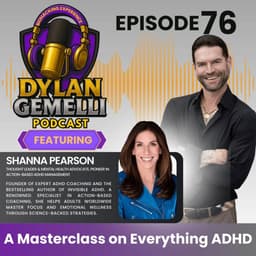
The Dylan Gemelli Podcast
What ADHD Is, and How It Shapes Life and Relationships
On episode 76 of The Dylan Gemelli Podcast, Shanna Pearson, founder of Expert ADHD Coaching and author of Invisible ADHD, explains to Dylan Gemelli what ADHD is, how to recognize it, and why so many adults with ADHD, women especially, are told first that they have anxiety or depression.
She also talks about why she agreed to write the book, what gets in the way of listening in relationships, and how Expert ADHD Coaching works from week to week.
In this episode
- Why Shanna said yes when her publisher asked for the book: to put the tools from the coaching program within reach of people who can’t join it
- How dopamine figures in ADHD, and why it can feel like every part of your life is happening at once
- Positive stimulus in place of the habits that get you into trouble: moving your body, physical state changes, and small wins you’re sure to get
- Overwhelm as the telltale sign, and why a family doctor’s anxiety questionnaire can lead to the wrong diagnosis, with Shanna reading the GAD-7 aloud
- How ADHD affects relationships and listening, and nodding along as self-preservation
- How the coaching works: doing things on the spot with a coach, one focus to practice every day, and sending proof that it’s done
Episode links
- The episode page on Podbean, with the show notes
- Spotify and Apple Podcasts, where it’s listed as episode 76
Transcript
This transcript follows the audio episode above. Times are minutes and seconds into it. The episode opens with a sponsor message and Dylan’s introduction of Shanna.
Dylan Gemelli (0:00): (upbeat music) Today's episode is sponsored by Apollo Neuro. Apollo Neuro is the leading doctor-recommended wearable technology. Apollo's award-winning SmartVibes AI works effortlessly behind the scenes, automatically integrating into your life to deliver gentle, personalized vibrations that activate your vagus nerve, helping you fall asleep faster, stay asleep longer, and wake up balanced, focused, and ready each day. Not only that, but the Apollo Neuro is the first and only wearable that improves your HRV. Apollo is effortless. Simply wear it throughout the day and night, and let it do the work for you. It's safe for anyone and everyone with no side effects and is the only wearable that can be worn anywhere on your body. Optimal health requires both the mind and body to be in line, and Apollo is the key to establishing that connection.
(1:07) Check the description below to save $90 with my special discount. Take control over your health today with Apollo Neuro. All right, everybody, welcome back to the Dylan Gemelli Podcast. So I have an amazing and very special guest today, and she is the first expert I've had on this topic on my show, so it's going to be a home run, I can guarantee you. I do want to point out before I give her the intro that she just released a new book. It's called Invisible ADHD: Proven Mood and Life Management for Smart Yet Scattered Women. However, it's for all people, she did make that very clear, for women and men. The point here, instant, that's right, instant USA Today bestseller. You do not see that often, and when you do, it's obviously with good reason.
(1:59) So she is the founder and president of ADHD Coaching. It's the largest ADHD coaching program of its kind in the world, and what they do is provide one-on-one action-based coaching for easily distracted adults that are seeking personal, professional, and financial success. She has over 26 years of experience, and she has designed and led focused and goal achievement programs for executive and directors at Fortune 500 companies and world-class institutions, some of which would include Google, Tesla, PayPal, Ford Motor Company, Meta, Johnson & Johnson, Apple, SpaceX, the list goes on. She's helped tens of thousands of adults transform their lives through her results-driven, brain-focused based approach. And also, she has degrees in psychology and education, and her credentials incru- include a lifetime spent mastering her own ADHD.
(3:06) And she also personally trains, certifies, and mentors all coaches in her proprietary action-based coaching method, and she oversees more than 60,000 coaching sessions each year. She's been featured on NPR, Fox, NBC, Global TV, CTV. I could keep going on, but I think we need to get into the conversation. So my friends, instant bestselling author, Shanna Pearson.
Shanna Pearson (3:36): Woo-hoo! (laughing)
Dylan Gemelli (3:38): I'm out of breath.
Shanna Pearson (3:39): Wow, that was impressive. (laughing) That's awesome.
Dylan Gemelli (3:45): I told everybody-
Shanna Pearson (3:46): ... Hear, like, all the credentials, like, stacked up in a paragraph like that, and, and then like, "Oh, my God. Wow, I want to meet this person." That's really cool. (laughing)
Dylan Gemelli (3:54): You know what I, I- I'm known for my intros, by the way.
Shanna Pearson (3:57): Oh.
Dylan Gemelli (3:57): I say that every episode. No, I'm just kidding. But one thing that you do... y- you know, that I notice is sometimes when you do something for so long, you don't realize all that you've actually done until somebody breaks it down and tells you. You know? And it's-
Shanna Pearson (4:11): Yeah.
Dylan Gemelli (4:12): How does that feel?
Shanna Pearson (4:14): It feels like a lot. It's like, "Oh, my gosh, I'm so tired." (laughing) Like, "When do I get to take a nap?"
Dylan Gemelli (4:21): (laughing)
Shanna Pearson (4:22): Yeah. (laughing) No, it feels amazing. It, it's, it's amazing. The book, uh, being (chuckles) an instant bestseller was, was shocking. It was like, "What? When you talk... Like, that doesn't, that doesn't make sense. Did they count it right?" (chuckles)
Dylan Gemelli (4:35): Mm-hmm.
Shanna Pearson (4:35): And then I got all the stats, and, and it was like, wow, that's, that is just awesome. I'm, I'm so grateful that people are finding the book.
Dylan Gemelli (4:45): Well, let... You know, and, and now before we get into some other things, let's talk realities on books and book sales. You know, one of the things that I've learned getting into what I do is that everybody wants to have a book, and a lot of people spend a lot of money to make a book. But in general, it's kind of used more for promotion or to say you have a book. It's not, like, to the levels of what you're doing here, and this is a testament to how good and respected you must be because this sold so fast. And most of the times, like I say, you don't see people selling a ton of their books. It's more for promotion, "I've got a book." That's-
Shanna Pearson (5:20): Yeah, it's like a business card. It's like a very long business card.
Dylan Gemelli (5:23): Yes, a very expensive one, is what I'm learning. And-
Shanna Pearson (5:26): Mm-hmm
Dylan Gemelli (5:27): ... so I guess my point here is this is a real testament to you and what you do and the impact you're having for it to sell that quick, that fast. And, you know-
Shanna Pearson (5:37): Yeah
Dylan Gemelli (5:37): ... I, I wonder how that feels to you gratification-wise, and do you feel like, "Wow, I'm really resonating with people and doing what I'm, you know, intend to do here, which is to change lives?"
Shanna Pearson (5:50): So it's, it's super... It's, it's a fantastic question, and what you're pointing out is just, like, bang on. I did not intend to write a book.
Shanna Pearson (6:02): ... so most people, as far as I know-
Dylan Gemelli (6:05): Mm
Shanna Pearson (6:05): -um, write a book, and they do it for exactly what you just said. They, they use it as a business card. Like, "Okay, I wrote a book. I can now say I'm an author, and, oh, if I get to be an Amazon (chuckles) bestselling author in some random category, I can put bestseller beside my name." And, um, you know, you can make money if you sell a lot, and all of that, and it- I have never thought of doing that. Um, I never wanted to write a book. I'm not an author, I'm not a writer. Although I am now, I guess, (chuckles) but I'm okay. It's not part of my identity. The, the publisher, Macmillan Publishers, they came to me.
Dylan Gemelli (6:39): Right.
Shanna Pearson (6:39): And they found me, and they asked me, "Please write this book, and we want it to be, you know, for to help women with ADHD." And the only reason... So it kind of just came at me. It was, it was not, you know, some people, like, write it and then they'll shop it around and get a, and get an agent and then get a publisher. But they came to me. I said yes for one reason only, and it's- the reason I said yes is because, um, our coaching program is not accessible to everyone because it can be, you know, it can be pricey, and it can be... It's a commitment, right?
Dylan Gemelli (7:16): Mm.
Shanna Pearson (7:16): Like, it's not a, it's not- we don't lock people into programs, but people have to be, like, ready to, ready to roll. And then so it's like signing up for, like, a, you know, a personal trainer. Like, you're not, you're not there to, you know, lose two pounds.
Dylan Gemelli (7:29): Mm.
Shanna Pearson (7:29): You're there to get in shape. It's like a commitment. You're, you're going from here, before picture to after picture.
Dylan Gemelli (7:35): Right.
Shanna Pearson (7:35): And our, our coaching program is like that, too. And so, you- number one, you have to be able to, to commit mentally, and number two, you have to be able to afford it. And there are a lot of people that come to us who can't do it. They can't do it, and they're in so much pain, and their lives are falling apart, and they're losing... You know, their careers are falling apart, their family is falling apart, their health is falling apart. And as the business owner, I can't- I honestly can't stand it.
Dylan Gemelli (8:07): Mm.
Shanna Pearson (8:07): It, it drives me crazy how many people need this so badly, and, and they c- and they're not able to afford it usually. Or they just don't have the time because they have three kids, and they're a single parent. Name it, right? And so after years of this, I just, I was like, "I can't do anything..." We're, we're not- I don't even think we're that expensive, but for some people, they can't afford it.
Dylan Gemelli (8:30): Mm.
Shanna Pearson (8:30): And we have to pay our coaches, or I won't have any coaches, (chuckles) and then I won't be able to, like, help these people. So I can't do anything about certain things, but what I was able to do is take the, like, so many golden nuggets from our coaching program that have been helping, you know, oh, my gosh, like, tens of thousands of people over decades, and put it in a book and then give it all away. You know, like, some people-
Dylan Gemelli (8:56): Mm
Shanna Pearson (8:56): ... they'll put, like, one big thing in a book, and it's like, you know, like, like Mel Robbins, like, let them. (chuckles) There's one concept, and let, let's put it into a book, and, and that's amazing! I literally put, like, over 100 freaking incredible concepts and techniques and tools into this book, and I just want people to have it because people need it, and people deserve it, and it certainly doesn't cost what a coaching program costs. And so when it became an instant bestseller, I sort of... And you're gonna think this is super flaky, but I sort of thought, like, this is the universe just saying, like, "This is why you did this."
Dylan Gemelli (9:37): Mm.
Shanna Pearson (9:37): It was the right, it was the right choice-
Dylan Gemelli (9:39): Yeah
Shanna Pearson (9:39): ... because it was really hard, you know? And every time- I was second-guessing it for three and a half years. Like, "Why am I doing this? Why am I doing this? (chuckles) Why am I doing this?" But, um, but that was why I did it, and I think that was just, like, something and the universe just had to tell me, like, over the head, like, "Hello, this is why you did it."
Dylan Gemelli (9:55): Well, and, you know, people don't just come to you write a book randomly. I mean, you have to-
Shanna Pearson (10:01): No, I know. (chuckles)
Dylan Gemelli (10:03): ... You have to possess something extremely special for a publisher to come to you-
Shanna Pearson (10:09): Right
Dylan Gemelli (10:10): ... and it not be vice versa. 'Cause, like, I would venture to guess from everything that I've been in behind the scenes, 90% of the people that are writing books are going to the publisher, like-
Shanna Pearson (10:19): No, I know.
Dylan Gemelli (10:20): Mm.
Shanna Pearson (10:20): That's how it usually goes.
Dylan Gemelli (10:21): Yeah. I mean, I've seen it all. We're- y- you're not James Patterson here. You don't have the means-
Shanna Pearson (10:25): No
Dylan Gemelli (10:26): ... of writing fiction novels that everybody wants to read either.
Shanna Pearson (10:29): Right, right.
Dylan Gemelli (10:29): You know? So, one, it's getting somebody interested that wants to publish it, and then two, it's getting the fascination of people, which is not easy, especially when you're covering a topic of people that can't pay attention in the first place.
Shanna Pearson (10:42): I know.
Dylan Gemelli (10:42): Well, I, I mean, what is that telling you? I, I-
Shanna Pearson (10:45): Yeah.
Dylan Gemelli (10:46): If you look at it, that just kind of came to me. Now, not only is it a big thing to write the book and get people, but you're appealing to an audience who's having struggle, you know, focusing anyway.
Shanna Pearson (10:58): Yeah.
Dylan Gemelli (10:58): So-
Shanna Pearson (10:58): Starting or finishing a book. (chuckles)
Dylan Gemelli (11:00): Exactly.
Shanna Pearson (11:01): Yeah. Yeah.
Dylan Gemelli (11:02): So, so I've read a ton of books, and sometimes you get a book that when it's conceptual based, and it's not mystery or whatever kind of novel, it's a lot of verbiage that doesn't go anywhere, and it is a lot of the same thing being regurg- regurgitated in just different ways of conveying the same message. So when you're telling me you're giving away all these concepts, that also is a big deal because I think a lot of people, when they write a book, that are kind of doing an informational book, it's almost leading people to try to get them to come take their class or whatever they're selling.
Shanna Pearson (11:41): I know.
Dylan Gemelli (11:41): Yeah.
Shanna Pearson (11:42): Yeah, I was so conscious about that.
Dylan Gemelli (11:44): Mm.
Shanna Pearson (11:44): Don't sound salesy. I don't even, I didn't even r- I'm like, every time I mention coaching, I'm like, "Or you could do this or that or the other thing." Like, don't... It's not about that. It's not about getting clients. We don't need that. I mean-
Dylan Gemelli (11:55): There's, there's-
Shanna Pearson (11:55): ... it's lovely, but we don't need it.
Dylan Gemelli (11:56): Yes. So I'm a, a deep, um, analytics guy and reviews guy and research what people are really saying, not fake stuff, real stuff. So these are all the hurdles and the-... I always look for barriers to entry on anything that I do, and for when I'm advising or helping somebody, what's the barrier that you have to overcome to make this successful? And it starts with motive, and then it goes, just goes from there on factually down. And I think that my point here is that it's very clear and evident that you took all of the right steps with the right reasons and did the right things, and this is what comes from it, so I applaud you.
Shanna Pearson (12:35): Thanks. Thank you. That means a lot. Thank you.
Dylan Gemelli (12:38): Well, it's-
Shanna Pearson (12:39): Thank you
Dylan Gemelli (12:39): ... it's nice-
Shanna Pearson (12:40): Yeah
Dylan Gemelli (12:40): ... you know, because there's so many people with bad motives, unfortunately, but there are people with good ones. You just have to find them.
Shanna Pearson (12:47): There really are. You have to find them! Uh, yeah, you have to find them. And they're not... Like, I'm not on social media, you know?
Dylan Gemelli (12:54): Mm-hmm.
Shanna Pearson (12:54): I, like, barely. (chuckles) Like, so-
Dylan Gemelli (12:56): Mm-hmm
Shanna Pearson (12:56): ... I'm actually very hard to find. Um, but there's others, there's others like us.
Dylan Gemelli (13:01): Yeah.
Shanna Pearson (13:01): There really are. Yeah.
Dylan Gemelli (13:03): I try to find them, and, and you know what? It's funny, they get brought to me, and that's God's work. They just get brought to me. And I try to, when I'm looking through people, I don't have a team that vets people. I do it, because I know. The only other team I have is my wife, because she can read people, like, inside and out, that I'll say, "What do you think?" But otherwise, I do it, because I would miss so many things if I let superficial people handle all of that stuff, that only looked at numbers and didn't look at the person or what they're doing.
Shanna Pearson (13:35): Mm-hmm.
Dylan Gemelli (13:36): So thank you.
Shanna Pearson (13:37): I love, I love it. Yeah, I love it. I am exactly the same way.
Dylan Gemelli (13:41): Mm.
Shanna Pearson (13:42): When, when people apply to work for my company, I'm the one that does the interviews. (chuckles) I don't have a... Like, I don't have anyone on my team doing it. I have to do it because I can feel these people, and whether they're-
Dylan Gemelli (13:52): Right
Shanna Pearson (13:52): ... good or not, or if it's a fit or if it's not a fit.
Dylan Gemelli (13:55): Well, how would you know if they resonate with you or not, you know? And it's not a-
Shanna Pearson (13:59): Yeah
Dylan Gemelli (13:59): ... it's not a control thing, it's not a macho thing, it's a, it's a trust thing for me, you know? And so-
Shanna Pearson (14:06): And you resonate, you know. Well, you do know, like, you can feel it, I think.
Dylan Gemelli (14:09): Yeah. You click very quickly, and you can read an individual and what their motives are, for the most part. There's some slick people out there, but let's talk about the concept of ADHD, because... And I use this word "polarizing," and when I say that word, I mean it probably differently than a lot of people do. When I say polarizing, it's just another way of me saying misunderstood. And so I think there's people that understand it, and there's people that don't.
Shanna Pearson (14:40): Oh, for sure.
Dylan Gemelli (14:41): And for me, it would be great if you would just break it down to people what exactly it is in simple terms, and then get a little bit more intricate into the details for you on why it's passionate to you, why, why does it mean so much to you? And I know that you've battled it yourself, and I like to hear the story because everybody's got a reason for why they get passionate about something.
Shanna Pearson (15:02): Yeah.
Dylan Gemelli (15:02): And so it's great to know what drives you, what motivates you, what makes you do this.
Shanna Pearson (15:08): Yeah, well, there's a lot. (chuckles) There's a lot that makes me-
Dylan Gemelli (15:11): Well, go ahead
Shanna Pearson (15:11): ... do this. There's- it's, um, ADHD, um, in its essence, is basically your, um, your brain has a deficiency in dopamine.
Dylan Gemelli (15:21): Mm-hmm.
Shanna Pearson (15:22): End of story. And you're born that way. ADHD is not something you catch, it's not something you get from eating, you know, red dye or watching too much TV as a kid, or... And, and all of those things, you know, like, all of the things that people are like, "Well, maybe you should try this," or, "Maybe you should get more sleep or eat less sugar," um, those, those things exacerbate ADHD symptoms, but they're not ADHD.
Dylan Gemelli (15:46): Got it.
Shanna Pearson (15:46): So people who have ADHD, it's important for everyone to know that those people were born like this. Just like you're, you're born with, you know, I- like, you're (chuckles) with any "disability," quote, unquote. It's just the way your brain is wired, and it's not actually a disability, but it is something you have to learn how to manage.
Dylan Gemelli (16:10): Got it.
Shanna Pearson (16:10): And so, and so when people say, "Oh, my gosh, like, life is so..." Like, during the pandemic, right? Everyone's like: "Oh, I feel so ADHD." It's, it's very minimizing, 'cause it's not stress and chaos and, you know, disarray. Those are- that is not what ADHD is. ADHD is a deficiency in dopamine. The way to increase dopamine is through stimuli. That's why ADHD medication is a stimulant.
Dylan Gemelli (16:40): Mm.
Shanna Pearson (16:40): Most of the time, they're stimulants, um, for better or for worse, that's just what it is.
Dylan Gemelli (16:44): Mm-hmm.
Shanna Pearson (16:45): And it is also why people who have ADHD tend to, and I talk about this a lot in the book, unconsciously create stimulus, whether it's, you know, just, like, constantly looking for something else, whether rather than just being totally present or constantly, you know, catastrophizing or ruminating or creating, like, you know, a million different scenarios in your head, um, when you're supposed to be present. Whatever your way of creating stimulus is, it's because that's what we need, you know? That's what our brain requires. It's like food for our brain, and so that is what ADHD is. It's painful to live with it and not know you have it, because you're behaving in ways, you know, where you're unconsciously creating stimulus. Um, it tends to get you in trouble at work, at school, in relationships, name it. Um, you don't know why you do what you do. You don't know why you're on a different frequency as everyone else on the planet.
Dylan Gemelli (17:44): Mm-hmm.
Shanna Pearson (17:44): You don't know why you're constantly- you know, you can't stop interrupting people, (chuckles) right? 'Cause you already know what they're gonna say. (chuckles) You're already at the end of their story, even though they just said the first sentence. And a lot of this is, like, you just don't know why. And so when you're living like this as a child, and then as a young adult, and then as an adult, and you still don't know why, um, but things are not working out for you, it sucks.
Dylan Gemelli (18:08): Mm-hmm.
Shanna Pearson (18:08): It sucks, 'cause nothing is working out. And even the things that are working out, they work out because you're working extra, extra hard at them.
Dylan Gemelli (18:19): ... Got it.
Shanna Pearson (18:19): And so it's just, it's just difficult. That's it. And in essence, I think for people to understand what it's like, and it's imagine, like, most of- most neurotypical people, they're able to compartmentalize.
Dylan Gemelli (18:34): Mm-hmm.
Shanna Pearson (18:35): Right? Like, Dylan, you know, you've got your podcast to do, you've got something to do with your wife later, you've got something to do with, you know, uh, some friends later on and after that, and you can kind of, like, put things in boxes.
Dylan Gemelli (18:43): Mm-hmm.
Shanna Pearson (18:43): You know, like they've got their place. People who have ADHD are not able to compartmentalize very well.
Dylan Gemelli (18:51): Got it.
Shanna Pearson (18:51): So we live, whether you're male or female, (chuckles) we live inside of an everything all at once right now reality, where every category of your life is all happening at the exact same time in your brain right now, and yesterday, and tomorrow, instantly. And so that is why (chuckles) it is very difficult to be organized, on time-
Dylan Gemelli (19:20): Mm-hmm
Shanna Pearson (19:20): ... uh, present.
Dylan Gemelli (19:21): Right.
Shanna Pearson (19:22): That is all why, because in our brain, it's all happening all at once. Everything, everything. There's nowhere to put anything. If something happens in your relationship, you know, part of life, it infiltrates, it, like, drips down and sucks up everything in your career, in your, you know, any- your health. Like, it just, there's no separation between-
Dylan Gemelli (19:41): Mm-hmm
Shanna Pearson (19:41): ... anything, and that is a hard way to live.
Dylan Gemelli (19:45): Yeah, I, I understand thoroughly. Let me ask you this, and thank you for the breakdown, I appreciate it-
Shanna Pearson (19:50): Yeah
Dylan Gemelli (19:50): ... because it's, you made it very easy to comprehend and understand. I, I do wonder how prevalent of a problem is this, I guess we'll call it condition or-
Shanna Pearson (20:02): Sure, condition
Dylan Gemelli (20:03): ... you know-
Shanna Pearson (20:04): Way of being?
Dylan Gemelli (20:05): Yeah. How prevalent, like, would you say... I'm sure you would have a statistic, 50% of people have this problem? And-
Shanna Pearson (20:14): Yeah
Dylan Gemelli (20:14): ... also, to expound on that question, do you find that it gets worse, and worse, and worse over time, or is that dependent upon the treatment, and the person, and the way they were raised, or their circumstances? What, what are some contributing factors?
Shanna Pearson (20:32): I think if you have... Here's the thing. I- if you have ADHD and it goes untreated, it will get worse.
Dylan Gemelli (20:41): Right.
Shanna Pearson (20:41): Because like I was- the ADHD doesn't get worse, but you feel worse-
Dylan Gemelli (20:46): Okay
Shanna Pearson (20:46): ... because, because now you have, um, you know, now (chuckles) you have like 10,000 more failures under your belt.
Dylan Gemelli (20:53): Mm-hmm.
Shanna Pearson (20:54): Okay? And now you've just lost your 15th job in the last 10 years. (chuckles) Rather, you know, like, and now, again, you know, your marriage didn't work out. Again, (chuckles) you know, maybe it's for the third time, maybe it's for the fourth time, I don't know. But as the failures, s- and I'm gonna say failures just straight up, because that's what people feel it as-
Dylan Gemelli (21:15): Mm-hmm
Shanna Pearson (21:15): ... and that's what the reality is for them, um, before they reframe it. (chuckles) But, you know, if, if you keep stacking these up over time, by the time you're in your 50s and 60s, like, people are literally saying that they haven't amounted to anything, at all. And, you know, there's no relationships left, like, even with their, with their spouses, or with their children, or their, their parents, or it's just, it's just... It's, it gets sadder and sadder. Versus the, the, you know, the younger people (chuckles) that, you know, have ADHD, that come to us and they're, you know, entering college, um, and they're just frustrated-
Dylan Gemelli (21:56): Yeah
Shanna Pearson (21:56): ... but they're not, they're not so, I guess, just, like, hopeless.
Dylan Gemelli (22:02): Mm-hmm.
Shanna Pearson (22:03): As, uh, in general.
Dylan Gemelli (22:06): Right.
Shanna Pearson (22:07): In general. So in that way, it gets worse.
Dylan Gemelli (22:10): Mm-hmm.
Shanna Pearson (22:10): Um, also, the way that you do things in your life, and you know this because of what you do, the way you do things in your life become habitual.
Dylan Gemelli (22:17): Yeah.
Shanna Pearson (22:18): So if you're always, you know, waiting till the last minute, and you're habitually procrastinating, and you're habitually catastrophizing, and you're habitually arguing, 'cause there's, you know, people that are, like, argumentative, like they just- that's just how they are, and they've never tried to stop, it's, it's just gonna keep, you know, it's just gonna keep accumulating upon your health.
Dylan Gemelli (22:36): Right.
Shanna Pearson (22:36): That's it.
Dylan Gemelli (22:37): Yeah.
Shanna Pearson (22:37): So that's how it gets worse.
Dylan Gemelli (22:39): Do you find that people that are lacking in certain areas, so like s- they're lacking in sleep, for example, d- does that contribute to it? Are there any things that people are doing that they're not... Highly stressed individuals, um, people with hormone problems, low testosterone levels, does any of this correlate or relate at all, or-
Shanna Pearson (23:02): Totally. Well, well, you know, in terms of, you know, for women, for sure.
Dylan Gemelli (23:06): Mm.
Shanna Pearson (23:07): As they get into midlife and then later in life, and they go through perimenopause and mary- and menopause, like, those, you know, estrogen affects dopamine.
Dylan Gemelli (23:15): Yes.
Shanna Pearson (23:16): So, so now if your, if your estrogen levels are declining naturally because of the phase of life that you're in, and it's causing you to have even less dopamine, you can imagine what that does to a woman who has ADHD and already has low levels of dopamine, right? It's also why people, all women, like, for sure, women who have, you know, whose estrogen levels are declining, they feel like they have ADHD even if they don't have ADHD, because the- because they have less dopamine.
Dylan Gemelli (23:47): Right.
Shanna Pearson (23:48): There's almost like that brain fog that everybody talks about is-
Dylan Gemelli (23:52): Yeah
Shanna Pearson (23:52): ... is very similar, it's very similar to ADHD.
Dylan Gemelli (23:56): Yes.
Shanna Pearson (23:56): Now-
Dylan Gemelli (23:57): Let me ask you this then: Are there natural supplements- because, like, for instance, one of the things that I talk to a lot of women in menopause is creatine, and it, and the way that it helps them through menopause. Are there supplements... We're gonna get into medications a little, in a little bit in terms of, of menopause and everything, but m- I, I'm wondering if there's natural supplements that could be of benefit to people that are suffering from it. Because you know, you and I both know-... There are plenty of people that don't want to take any sort of pharmaceutical medication whatsoever. We're gonna get into if it's needed. I know that there are, are probably gonna be some instances where it is and where it's not, 'cause that's kind of standard with anything. But is there any natural things that you can recommend or that you've seen work?
Shanna Pearson (24:44): Um, there are no natural sup- supplements that I can recommend, because when, when I hear a client or even three clients raving about a supplement, and then we're, like, sharing it with other clients, it, it's like, it's almost, like, guaranteed that, that a bunch of other clients are gonna get sick from it.
Dylan Gemelli (25:04): Sure. Uh-huh.
Shanna Pearson (25:05): Are gonna have, like, really adverse effects, and it's like, "Okay, we can't do that anymore." (chuckles) It's like-
Dylan Gemelli (25:10): Yeah
Shanna Pearson (25:10): ... "It's great that it worked for you. It didn't work for you." I'm not a doctor, you know. Like, all I can say is that, like, 100% of the time, moving your body, you know, is a great way to create... I call it positive stimulus. So if you think about it, we need, we need stimulus, period, end of story. That's what ADHDers need, male or female. So what are the ways that you can create positive stimulus versus negative stimulus, right? Because the negative stimulus is always, like, the stuff that you do that, that gets you into trouble.
Dylan Gemelli (25:41): Right.
Shanna Pearson (25:42): You know? Like, just name it. Like, we all have, like, 20 different habits that we do that get us into trouble that's also, you know... Whereas that's a- that's also ways, you know, where, you know, a lot of women, you'll find that they're addicted to drama, and, and they don't, they don't realize it even, but that's, like, a thing. Inability to make decisions-
Dylan Gemelli (26:00): Mm-hmm
Shanna Pearson (26:00): ... that for men especially, (chuckles) like, that's just so... You know, the whole, um, getting into, you know, relationship issues where, you know, like, ex- you know, other relationships inside of your relationship, and just name it. Just all of these things that we're trying to jack up our lives a few notches are negative stimulus if it's-
Dylan Gemelli (26:22): Mm
Shanna Pearson (26:22): ... if it's damaging what's in your life, right?
Dylan Gemelli (26:25): Right.
Shanna Pearson (26:25): So, so basically, the positive stimulus would be, um, in terms of non-medication, is really I, I, I, I could break it down into two big categories, which is moving your body and physical state changes, which is huge, and emotional stimulus, which would be having something really flipping great in front of you and working towards it.
Dylan Gemelli (26:54): Got it.
Shanna Pearson (26:54): Because that win every day of whenever you've taken a step forward towards anything that you actually want, there's honestly nothing like that, and you know that-
Dylan Gemelli (27:05): Mm
Shanna Pearson (27:05): ... based on your own experience.
Dylan Gemelli (27:08): Every day, so I do heavy amounts of cardio every day, like 90-minute sessions, and I'm telling you that that is one thing daily where I always feel accomplished.
Shanna Pearson (27:19): Yeah.
Dylan Gemelli (27:19): Okay?
Shanna Pearson (27:20): Yeah.
Dylan Gemelli (27:20): So I could be having the worst day ever, and as soon as I go do that and I finish and I got through it, I feel like I, I really, I'm feeling accomplished.
Shanna Pearson (27:30): Yeah.
Dylan Gemelli (27:31): And I think... This is a c- a sports concept. So my dad would always tell me, "When you're having a bad shooting night, just make a shot, make a layup, make something," and instantly you're going because you know that you can do it. You just had to get out of your funk, and then you feel it, and then you go.
Shanna Pearson (27:46): Yeah.
Dylan Gemelli (27:47): And what you're saying, I see how it could break, well, you know, the, the, I don't want to call it a trance, but that loss of, of, uh-
Shanna Pearson (27:56): Direction
Dylan Gemelli (27:56): ... direction when you're having brain fog, like I'm just having right now. And but, but-
Shanna Pearson (28:00): (chuckles)
Dylan Gemelli (28:00): ... doing something like that, it's like, boom, pop! Okay, let's go. You know, I, I'm back.
Shanna Pearson (28:05): Yeah.
Dylan Gemelli (28:05): So I, I-
Shanna Pearson (28:05): Yeah
Dylan Gemelli (28:05): ... see what you're saying, and I could see-
Shanna Pearson (28:07): Yeah
Dylan Gemelli (28:07): ... how that would work tremendously. Um, that's really good advice because the, one of the things I've learned-
Shanna Pearson (28:14): Uh-huh
Dylan Gemelli (28:14): ... yeah, well, in biohacking, right? It's like the most basic thing, if I just tell you, "Just take a walk in the morning," and it's like: Man, how did I not know that? But you need somebody to tell you.
Shanna Pearson (28:24): You need somebody to tell you, and you need to break it down.
Dylan Gemelli (28:26): Yes.
Shanna Pearson (28:27): Right? Like, put your shoes somewhere that you're gonna actually see them, so that you put them on while you're making your whatever, coffee-
Dylan Gemelli (28:33): (chuckles)
Shanna Pearson (28:33): ... tea, whatever. And then when your shoes are on, it's a lot easier to get out the door.
Dylan Gemelli (28:37): Yes, 100%.
Shanna Pearson (28:39): But, like, everything has to be broken down into wins.
Dylan Gemelli (28:42): Yeah.
Shanna Pearson (28:42): I think if you, if you're living a life on a path of small wins, and most of us don't think like this. Most of us do not think of wins. We're just thinking of survival and getting through the day.
Dylan Gemelli (28:53): Mm.
Shanna Pearson (28:53): But if there's something that's even a little bit interesting to you or something that you stopped doing that you wish you hadn't stopped doing, (chuckles) and you wanna just, like, do it again, but not in such a... Like, when you're like, oh, you know, you do, like, 90 minutes of cardio, like, for a lot of people, 90 seconds would be a huge, freaking huge goal.
Dylan Gemelli (29:12): Mm.
Shanna Pearson (29:12): We could do 90 seconds of cardio a day. How about 10 seconds? You know, like, just, just make it so that you can actually win, and make it so that it's a guaranteed win, and keep stacking those wins.
Dylan Gemelli (29:26): Yeah.
Shanna Pearson (29:26): And eventually, you're gonna be- you're not gonna be, like, seeking out the neg- unconsciously seeking out the negative stimulus because your life is gonna be, you know, start to become more full of stimulus that actually works for you, which, by the way, is way more freaking engaging than the stuff that hurts you.
Dylan Gemelli (29:47): Yeah, that's right. When you see that, and you, and you see #winning, and, uh, that can mean so much for so many people-
Shanna Pearson (29:54): Yeah
Dylan Gemelli (29:54): ... in such a different variety of ways. You know what I mean?
Shanna Pearson (29:57): Yeah.
Dylan Gemelli (29:57): And I, I think when you look at that, and you get this picture in your head of what that means if somebody's writing it, and some people will look at that and think that the person is, like, feeling themselves. But, um, like, if I'm looking at it, I'm like: Man, what did you do? Like, what did you do? Let's hear it. You know, like...
Shanna Pearson (30:13): Yeah.
Dylan Gemelli (30:14): And it, it's a good feeling to write something like that and to feel that, and then it-
Shanna Pearson (30:17): Yeah
Dylan Gemelli (30:17): ... releases a dopamine effect or whatever positive effect that can really help you kind of stay balanced.
Shanna Pearson (30:24): Yeah.
Dylan Gemelli (30:24): So I see where you're going with that, and it makes total sense. So that resonates extremely well. So let's talk about-... signs? Let's, let's just say you got no clue, you know, that you have this going on. 'Cause I'm sure there are people that probably have it nowhere near as, like, prevalently as another person does. So somebody might, on the surface, just, you can just see it a mile away, and some person might have not understand or realize it, you know?
Shanna Pearson (30:52): A lot of people.
Dylan Gemelli (30:53): Yeah. What's some telltale signs?
Shanna Pearson (30:55): I think the number one telltale sign for all humans (chuckles) who have ADHD is, uh, is the experience of overwhelm all the time, and I, I think I- I literally say "overwhelmed all the time" should be the catchphrase for ADHD. Because when you have a brain that cannot compartmentalize, everything is happening all at once, no matter what's happening, even if there's nothing happening-
Dylan Gemelli (31:21): Mm-hmm
Shanna Pearson (31:21): ... right? It's still all, you know, like, all of the, you know, what's not happening is still all happening all at once. But if you've... You know, your three shows on Netflix that you haven't seen, like, "Oh, my God, I s- I have to watch those three!" But, like, real, you know, like, your, your... What's going on at work, there's always, like, a thousand things going on.
Dylan Gemelli (31:38): Mm.
Shanna Pearson (31:38): What's going on at home, if you have kids, if you have pets, if you have a partner, if you don't have a partner, (chuckles) right?
Dylan Gemelli (31:46): Mm.
Shanna Pearson (31:46): Like, there's a whole bunch of stuff that goes along with that too. And so it's just- but it's all compiling upon itself, and you can't, you can't reach in and just take out one thing and look at it and be like, "Okay, this is how I can help with this, and this is how I can manage that, and here are the steps I need to take." It's like you're just so flipping overwhelmed by all of the different categories and things that are not working and everything that you need to potentially do to try to make it better, and it's just constantly feeling like you're a deer caught in headlights.
Dylan Gemelli (32:19): Mm-hmm.
Shanna Pearson (32:20): And I think that- And you just don't know what to do when. If you have the feeling often that you are a deer caught in headlights, and you're, like, frozen or paralyzed within that feeling and are not exactly sure what you need to do when, and that's been your story for a lot of your life, that would be a good telltale sign.
Dylan Gemelli (32:41): Okay. Got it. Makes sense.
Shanna Pearson (32:43): Yeah, and then, you know, if you think about it, if you're living inside of that overwhelm, how are you supposed to get anything done? Like, how, really? Tell me. Like, how do you go from point A to point B? Nobody knows. That's why I do what I do.
Dylan Gemelli (32:57): Mm-hmm.
Shanna Pearson (32:57): That's why I do what I do, because it's like you're- we're literally... Like when you were asking at the very beginning, like, what caused me to wanna do this? It's like, at the end of the day, having someone- and this is so the opposite of what coaching should be. What we do is really not what a lot of people say coaching should be. It's actually much more like athletic coaching. You know, you've got a coach, and they, and they're telling you exactly what to do. "Here's where you run, here's how much you do this, here's how much you lift there, and here's where you should pass," and all of that.
Dylan Gemelli (33:29): Mm-hmm.
Shanna Pearson (33:29): That's, that's what we do.
Dylan Gemelli (33:30): Mm-hmm.
Shanna Pearson (33:31): We're very directive. We're very directive because our clients and myself and so many- our people with ADHD are literally swimming in overwhelm.
Dylan Gemelli (33:41): So what's the first step for somebody that is la- you know, feeling like they have it, or they've got these signs? What, what should they do? What would you recommend them to do?
Shanna Pearson (33:51): I would recommend that they learn how to manage it and go get a diagnosis if they haven't already, so that they know exactly what's going on. Because you have to know what's going on and- if you wanna fix it.
Dylan Gemelli (34:03): Mm-hmm.
Shanna Pearson (34:03): You can't... You know, anything you have in your life that's broken that you need to fix, not that, you know, we're not broken, but if there's something that needs to be managed or fixed, you have to know what it is-
Dylan Gemelli (34:13): Mm
Shanna Pearson (34:13): ... or you're gonna be spending a lot of time patching up things that aren't the, the thing that needs to be fixed. That's why a proper diagnosis is really important.
Dylan Gemelli (34:21): So-
Shanna Pearson (34:21): A lot of people with ADHD are misdiagnosed initially.
Dylan Gemelli (34:24): And that where- that's where I'm going. So the chances are, and I'm not saying... I am not saying this is every single situation, but what I am saying is chances are high, you just go to a regular doctor, you tell them certain things, they just put you on something and send you on your merry way. 'Cause I can't imagine that they sit there and go longer than five or 10 minutes with you. That is just general practitioner behavior-
Shanna Pearson (34:47): Right
Dylan Gemelli (34:47): ... training. And, and so my question is: Where do you recommend somebody to go to get an accurate assessment and not just get thrown on m- possibly thrown on medications they don't need?
Shanna Pearson (34:59): Well, that's a whole- I wanted to, I wanted to, to t- to, um, to just mention that if you just tell your GP or, you know, your family practitioner, like, the person you go to for a yearly checkup, that you're, you know, you're feeling a little bit lost, you feel overwhelmed, you're- you know, y- this isn't working out, that's not working out, you don't know why, you're losing your patience, you're getting angry. That's a big one for, for, for men. They just, like, the frustration leads to anger, um, often, and they don't know why, and it's really hard for them to control.
Dylan Gemelli (35:33): Mm-hmm.
Shanna Pearson (35:33): So, so if they're telling their doctor about that, their doctor's gonna give them, like, s- uh, a self-assessment question for, you know, anxiety probably, or even depression in some cases, and the symptoms for anxiety and depression overlap with ADHD. So you'll more likely be diagnosed with anxiety (chuckles) or depression 'cause they won't think of ADHD, which is why I think you should go to an ADHD specialist.
Dylan Gemelli (35:58): Okay, so there are specialists that, that are there that you can go to and...
Shanna Pearson (36:03): Yeah.
Dylan Gemelli (36:03): 'Cause that, that w- my other concern was, is it easy to put somebody on an antidepressant when they don't need it or, like, say, Xanax or whatever you... Prozac, whatever they put you on anymore. I, I don't know what they give for anxiety anymore. I just know what the, you know, in the past. Um, uh, I mean, it's kind of scary. That's one of the things that I can compare and contrast, like, when I get people that come to me and say, "I'm tired. I need t- testosterone."
Shanna Pearson (36:29): Yeah.
Dylan Gemelli (36:30): You know, like, "Hold on a second here. Let me-
Shanna Pearson (36:32): Give me a prescription.
Dylan Gemelli (36:33): Yeah, let me do some digging first, please. Um, so-
Shanna Pearson (36:37): Yeah
Dylan Gemelli (36:37): ... is that a big problem? Do you see a lot of-... misdiagnosis or misprescribing, over-prescribing? Do you see this a lot? 'Cause I'm sure that you run into this.
Shanna Pearson (36:46): I see it all the time.
Dylan Gemelli (36:48): Uh-huh. I figured.
Shanna Pearson (36:49): I see it all the time, Dylan. I, I, I, I don't know of a s- (chuckles) I don't know of a single woman who's over the age of 30-
Dylan Gemelli (36:59): (exhales)
Shanna Pearson (36:59): ... diagnosed with ADHD, when she wasn't first misdiagnosed with either anxiety or depression.
Dylan Gemelli (37:05): Okay.
Shanna Pearson (37:05): It's like we all have the exact same story.
Dylan Gemelli (37:08): Mm-hmm.
Shanna Pearson (37:09): No matter where we're from, no matter where we live right now, no matter, no matter w- how much, you know, our, our, our, our body size, our, our net worth, it doesn't matter (chuckles) everyone has the exact same story. It's wild, and it's, and it's sad-
Dylan Gemelli (37:24): Yeah
Shanna Pearson (37:24): ... because, uh, like, these stories are still going on. It's like, you know, right now, today, after everything that we know, and, and the amount of, um, de-stigmatization around mental health, there's still so much misdiagnosis and mismedication. So, like, the amount of women who have ADHD that are, like, taking antidepressants, and it's not helping them, which, by the way, makes things a lot worse.
Dylan Gemelli (37:51): Right.
Shanna Pearson (37:51): Because now your doctor, (chuckles) your doctor just told you what to do. You're doing exactly what your doctor says, and you still feel like this, and things still aren't working.
Dylan Gemelli (38:00): Yeah.
Shanna Pearson (38:00): It's... That's, to me, that's- it's, it's tragic, and it's scary.
Dylan Gemelli (38:05): It's frustrating. That's why I do what I do, and I bring people like you on, and that are doing things in all different facets of health and wellness, that find this same problem related to their field, so that we can try to fix it and educate people on how to stop this shit that's going on, (chuckles) you know?
Shanna Pearson (38:23): There you go. So let me sh- can I show you? I don't know if this is gonna be on video, and I can read it out loud.
Dylan Gemelli (38:28): Yeah. We'll do-
Shanna Pearson (38:29): You know, this is the GAD-7, the Generalized Anxiety Disorder-7, that your doctor will give you in the United States, um, if you- if they're giving you a self-assessment for anxiety.
Dylan Gemelli (38:40): Okay.
Shanna Pearson (38:40): And every single one of these seven points are ADHD symptoms. That's how much overlap there is. So you will automatically get this, and you will be diagnosed with anxiety if you have ADHD. So it's like, so here's the anxiety questionnaire: feeling nervous, anxious, or on edge. There's no person with ADHD who doesn't experience that.
Dylan Gemelli (39:02): Yeah.
Shanna Pearson (39:02): Um, not able to control or stop worrying. There's no person with ADHD who doesn't have that, especially women. Worrying too much about different things. Trouble relaxing. (laughing) How wonderful! I'm sorry, but, like, come on. Being so restless that it's hard to sit still. Becoming easily annoyed or irritable. Feeling afraid, as if something terrible might happen. Catastrophizing is, like, our number-one go-to for creating stimulus. These are all ADHD symptoms, but this is the GAD-7 for anxiety.
Dylan Gemelli (39:35): Okay.
Shanna Pearson (39:36): So 100% of us will be misdiagnosed with anxiety if we have ADHD, and we don't check out the ADHD diagnosis, which, by the way, still needs work also. But you will be m- you'll- you're gonna get a diagnosis of anxiety if you have ADHD. That's what I'm trying to say. Because the symptoms completely overlap with each other.
Dylan Gemelli (39:57): What's the differentiating factors then?
Shanna Pearson (39:59): Overwhelm.
Dylan Gemelli (40:00): Okay.
Shanna Pearson (40:01): Exactly what I was saying before, and, and just in general, more in-depth knowledge around the ADHD. So for example, this is anxiety, but if you've had ADHD, let's find out if all of these symptoms are things that you've had for your entire life. Are you also... Like, do you also have a brain that has a hard time compartmentalizing, which then leads you to the overwhelm? Do you procrastinate often because you just don't know when or how to start? You need to go a lot deeper. You need to ask a lot more questions to get to the diagnosis of ADHD.
Dylan Gemelli (40:33): So I'm relating this to myself a little bit here, because I developed anxiety when I was about 18, 19, but there were situations that caused it.
Shanna Pearson (40:43): Okay.
Dylan Gemelli (40:43): So I'm saying, like, causation with anxiety, something caused it. It wasn't something you were mentally born with.
Shanna Pearson (40:51): Right. That's correct. Yeah, that-
Dylan Gemelli (40:52): Yeah
Shanna Pearson (40:53): ... that's totally different.
Dylan Gemelli (40:54): Okay.
Shanna Pearson (40:54): So yeah, a lot of people are like, you know, ever- a lot of people are like, "Since I had children,"" just saying, "you know, I felt, you know, a lot more anxious," because now you have these lives that you have to-
Dylan Gemelli (41:04): Make sure
Shanna Pearson (41:04): ... yeah, you're responsible for, which is very scary.
Dylan Gemelli (41:07): Mm.
Shanna Pearson (41:08): But ADHD is really... You know, I've had these symptoms for my whole life, plus I have all of these other symptoms that they are not asking about on the anxiety questionnaire.
Dylan Gemelli (41:16): Yeah.
Shanna Pearson (41:17): But if you have ADHD, and you're then taking an anti-anxiety medication, it's not gonna help your ADHD-
Dylan Gemelli (41:23): Mm
Shanna Pearson (41:23): ... as much as, and, you know, as much as managing your ADHD will.
Dylan Gemelli (41:27): Right.
Shanna Pearson (41:28): So-
Dylan Gemelli (41:28): Sure
Shanna Pearson (41:29): ... that's, that's- it's just really important that people get a correct diagnosis.
Dylan Gemelli (41:34): Yeah.
Shanna Pearson (41:34): So if you got a diagnosis, and you think that it's not working, or what your doctor is giving you isn't working, don't fret. Just get a different di- like, just go, just look into it a little bit more deeper. Maybe it is ADHD. Maybe it's something else.
Dylan Gemelli (41:50): Sure.
Shanna Pearson (41:50): So don't worry. Whatever it is, it's manageable.
Dylan Gemelli (41:54): So how does having ADHD tend to affect self-confidence, self-esteem, our abilities to converse with others, the relationships that we have with others? How does that damage a person's ability to do these things? Is it bad? Is it, is it manageable? Does it depend on the person?
Shanna Pearson (42:17): So number one, it's manageable, but it's bad because we never learned how to do it. Nobody knew. If, if you have ADHD, you didn't know you had it, right? Until you, until you're diagnosed. (chuckles)
Dylan Gemelli (42:29): Mm-hmm.
Shanna Pearson (42:29): So you just know that you're operating on a very different frequency as everyone around you.
Dylan Gemelli (42:35): Mm-hmm.
Shanna Pearson (42:35): And you don't know why. Because you're on a different... It's almost like it really, I think a frequency is the best word to describe it. Because you're, like, up here, you're, like, vibrating somewhere like this, and everyone else seems to be like this, going at their own pace, right? And you're like-... you're just not matching with the rest of the world.
Dylan Gemelli (42:53): Mm-hmm.
Shanna Pearson (42:53): And it's why you're- a lot of us think that we're very high speed, but we're not necessarily high speed, we're just ahead. We're, like, moving further. We're past, even though we're behind, if that makes sense.
Dylan Gemelli (43:06): Yeah, it does.
Shanna Pearson (43:06): Like, we're so- we're already, we're already on the, on the, you know, the 50th question of this interview when you're only on the 10th-
Dylan Gemelli (43:15): Got it
Shanna Pearson (43:15): ... if that makes sense.
Dylan Gemelli (43:17): Yeah.
Shanna Pearson (43:17): And, and yet we might not be, like, doing incredibly well at any of it. It's not like, "Wow, we're so amazing. We're so ahead of everyone." It's not that kind of ahead. It's almost like a, it's just a mental... Like, we're mentally past it, even though we're not anywhere near it. So this probably is making no sense. (chuckles) But-
Dylan Gemelli (43:36): No, it does. It does.
Shanna Pearson (43:37): Okay. So that's really hard when you're in a relationship, because you're constantly thinking, like... You're, you're just constantly thinking that the person that you're in a relationship with, or in a f- you know, it could be a romantic relationship, it could be a friendship, they're just not in alignment with you. And it's really hard to find people who are at the same frequency or the same speed. And when you do, it could be explosive, but not in a good way.
Dylan Gemelli (44:05): Mm-hmm.
Shanna Pearson (44:06): Right? 'Cause you kind of need somebody to balance you also. So there's a lot... There tends to be a lifelong feeling of being misunderstood by everyone. Because you don't feel gotten, you don't feel understood. You feel like even communications get missed a lot, because when someone's talking, you're already, like, at the end of whatever they were saying, so you didn't really hear what they were talking about. (chuckles) And you probably missed most of it.
Dylan Gemelli (44:35): Most of it, yeah. I-
Shanna Pearson (44:37): And now they're really mad at you- (chuckles)
Dylan Gemelli (44:39): Right
Shanna Pearson (44:39): ... because "Weren't you listening? You were standing right in front of me, nodding your head." (chuckles) Like, "Where were... Like, how did you miss this?" Right? But it's because you were with them, and then you were already past it.
Dylan Gemelli (44:51): Yeah. I, I give a lot of talks, and I do a lot of breakdowns and a lot of intricate stuff, and I'll see s- and there are so many times where I see people doing this, and they're like looking, and I'm like, "Man, shit, I, I don't know if you're, like, even there," (chuckles) you know, part of the time. So I-
Shanna Pearson (45:06): Yeah. Right.
Dylan Gemelli (45:07): Yeah. Yeah. No, I see it. I, I do, and I-
Shanna Pearson (45:09): When you're asking about relationships, I think that's the hardest place. I think that is the number one pain point.
Dylan Gemelli (45:15): Okay.
Shanna Pearson (45:16): I think that would... I would, I would venture to guess that, like, 98% of all of our clients have a hard time being in relationship. A lot of us are in relationships, and they're... A lot of times they're fantastic and good, but it's really, really hard. It takes, like, extra effort.
Dylan Gemelli (45:37): Yeah.
Shanna Pearson (45:37): It's not just about remembering, you know, "Let me... I hope I don't forget his birthday."
Dylan Gemelli (45:41): Yeah, and I see... I mean, for me, this is just a maybe a me thing, but I th- I, I really relate this to, in general, that I think the number one key to any successful relationship, whether it's marriage, friendship, whatever the relationship work, is communication, and if there's a struggle or a lack in communication, it can really make the relationship itself quite difficult to function properly and to ever be as good and tight as it could be. And I feel like people that are suffering from ADHD probably have a struggle with communication because of their lack of focus, and I think that maybe, and I'm... Look, I'm just spitballing here, but I think a lot of the nodding and a lot of the acting like they're hearing stuff they may not hear is to preserve that relationship or to make it feel maybe better than it, it actually is. And it's not on purpose, it's just I can't focus (chuckles) on you. I can't do this, I can't do that. Am I right? Am I crazy? You tell me.
Shanna Pearson (46:34): Um, you're right. It's definitely a self-preservation.
Dylan Gemelli (46:37): Yeah.
Shanna Pearson (46:37): If I, if I'm nodding my head, they're not gonna hate me. (laughing) They're not gonna, you know, they're not gonna break up with me today.
Dylan Gemelli (46:45): Yeah. (chuckles) Yeah.
Shanna Pearson (46:45): Yeah, no, I'm really here. And you know when you're saying you're here, and you're nodding your head, you realize that you're, you're still barely- you're trying so hard to pay attention. You're trying so hard, and it's not easy, right?
Dylan Gemelli (46:55): Yeah.
Shanna Pearson (46:55): It should not be that difficult. Um, I have a whole chapter in my book just on communication.
Dylan Gemelli (47:00): Mm.
Shanna Pearson (47:01): Just on communication. And the entire... I guess, the main theme are other- are ways to listen, 'cause we're horrible at listening because the volume in our brain is s- so loud.
Dylan Gemelli (47:15): Mm.
Shanna Pearson (47:15): It's so loud. So we've got this, like... It's not like we just have thoughts going through our head. They are loud, loud thoughts, and they are demanding our attention, and because the thoughts going through our head are usually more interesting than what the other person is talking about, our brain, which needs stimulus, is gonna, like, completely focus on the much more interesting thoughts going on in our head than on the, you know, probably somewhat boring, mundane thoughts that the other person is talking about.
Dylan Gemelli (47:42): Yeah.
Shanna Pearson (47:42): So that's gonna be where our brain is. We're not gonna catch on to what the other person is saying. So I have an entire chapter just on communication, which is really about how to listen so that you can actually grab what the other person is saying.
Dylan Gemelli (47:58): Maybe this is, like, the humanized side of me, maybe it's the- because I've been praying for more compassion in my life, but I feel almost, like, bad right now, thinking about a person that wants to hear and wants you to think they are, and they're struggling so bad. Like, I, I'm- internally, I'm actually feeling really sorry for the person that is struggling and, and how they may feel, and secondly, how I may have gotten pissy at someone in the past, like, "Why aren't you listening to me?" When they really can't.
Shanna Pearson (48:33): Right.
Dylan Gemelli (48:33): And it's not their fault, and I almost... Like, I, I feel bad right now, honestly, like, thinking about it from that perspective, 'cause I've never once looked at it like that. And I'm always Mr. "Oh, put yourself in someone else's shoes," but if you don't understand what they're dealing with, you can't. And so what you're saying-... actually just hit me in a way that I wasn't expecting. And I think maybe if it, it hit me like that, maybe other people listening, it will also hit them. Like, maybe you should think about that first before you just get mad at somebody or make them feel a certain way. Like, they might be struggling, and-
Shanna Pearson (49:08): They might be struggling.
Dylan Gemelli (49:09): Yeah.
Shanna Pearson (49:10): They might be struggling. You might know whether they are or aren't, right? Like, if they have other... If, if you think, wow, like, if you've ever thought, like, does, does this person just have a hard time being present in general in every area of your life- of their life, and you know it's not about you. Uh, whether they're listening to you or not, they just, they just have a hard time being present in anything, and that especially is really hard for them.
Dylan Gemelli (49:34): Yeah.
Shanna Pearson (49:34): It's really hard for them, and there's ways that they can listen better, and, you know, there's, there's things that they can do to help them become better listeners for other people, but, um, until they learn those ways, it's gonna be... It's one of the hardest things to do. So just if I were... Like, like, right now, whoever you're just thinking about, if there's anyone in your life that you think, like, Dylan, what you were just saying, like, now you're feeling really bad (chuckles) about-
Dylan Gemelli (50:03): Mm.
Shanna Pearson (50:03): ... you know, maybe they couldn't, just write their names down now so that you don't forget when-
Dylan Gemelli (50:07): Mm
Shanna Pearson (50:08): ... when our time is over.
Dylan Gemelli (50:10): Mm.
Shanna Pearson (50:10): And then you can reach out to them, and you can ask them, and you can just think about them a little bit more, like, solidly. Like, you know, maybe, maybe they just can't be present.
Dylan Gemelli (50:17): Yeah.
Shanna Pearson (50:18): Maybe they just have a really hard time with that. Um, maybe I can help them.
Dylan Gemelli (50:23): Yeah, I just, I think that maybe people should try to think about things more before you get upset with somebody or, or think they're just not listening to you on purpose. So it's something to consider. Now, if they're playing on their phone or something, that's something else, right? (chuckles)
Shanna Pearson (50:36): Absolutely.
Dylan Gemelli (50:36): (chuckles)
Shanna Pearson (50:37): Just put your phone down.
Dylan Gemelli (50:38): Yeah, seriously.
Shanna Pearson (50:39): Phone.
Dylan Gemelli (50:40): Um, let, let, let's shift now to what you do, how you help people, your, y- your work, so to speak, on, on what you've done your whole career now. What, what is it that people can come to you for help with, your coaching, your guidance? What is it that you actually do for people? Can you talk about the structure a little bit?
Shanna Pearson (51:00): Yeah. We, um... There's no two people that come, that, that come to us with the exact same issue or problems or-
Dylan Gemelli (51:07): Mm
Shanna Pearson (51:07): ... challenges. Uh, everything we do is very... It's, it's, it's, it's targeted to the individual. So if you were to come to me because, you know, for, you know, you had this... You know, you wanna get better at XYZ, and this is your number one- these are your challenges, but these are your goals, (chuckles) right? And this is what you want. We would, like, you're... You know, what we would do for you is, is, would be completely in alignment with helping you manage your challenges and making sure that you achieve whatever your goals are. Making sure of it. You know, basically creating, like, like, how you would create a, a food plan or... I don't know if you would do that, but maybe I would-
Dylan Gemelli (51:46): I do
Shanna Pearson (51:46): ... for somebody. But now we actually do it with you-
Dylan Gemelli (51:49): Mm
Shanna Pearson (51:49): ... and we make sure that we- we're watching you eat it. (chuckles) You know, like, we are making sure that you're doing it. We're not just giving you something and say, you know, "Bye, call us in a month." Like, every single week, we're, we're having you do things on the spot with your coach. You know, whether it's, like, creating, um, for your health, like, a plan, or whether it's creating, you know, some- something for, for you to better be able to, to manage your emotions, which I think is gigantic, because if you don't manage your emotions or your mood, how are you gonna follow through on any time management strategy you have? You're just not gonna feel like doing it, so you won't. (chuckles) So-
Dylan Gemelli (52:27): Right
Shanna Pearson (52:27): ... you know, I feel like mood and emotion management is, is gigantic. We do all of these things with you, and then you do it throughout the week, and then we give you a one focus that you have to practice every single day between your sessions. And then you have to send us, like, proof that you're actually doing it. So, like, we're all over you. It's really, it's amazing. It's like, it's, it's, it's exactly what I would need, which is why I've designed it like this. Like, it's like literally having a personal trainer with you, you know-
Dylan Gemelli (52:56): Yeah
Shanna Pearson (52:56): ... and watching you, watching you do the sit-ups to make sure you're p- you know, you're doing it correctly. Otherwise, you're just gonna hurt your neck. You know? And, and-
Dylan Gemelli (53:04): Right
Shanna Pearson (53:04): ... just, yeah, like, really fine-tuning and making sure you're doing everything and, and 100% guaranteeing wins.
Dylan Gemelli (53:11): I love it.
Shanna Pearson (53:11): 'Cause that's the stimulus that we need. We have to have those wins. And so... And the wins come from you, the cl- you know, or the client. Like, we're not gonna tell you what a win is. Like, you tell us-
Dylan Gemelli (53:20): Right
Shanna Pearson (53:21): ... and, and we make sure you do it, and then that just keeps... Everyone's, like, on fire. Everyone's on fire.
Dylan Gemelli (53:27): Mm.
Shanna Pearson (53:27): You know, it's like this win, and that win, and that win, and every month, we get wins, wins, wins, wins, and it's just like, it's unbelievable, and it's beautiful because a lot of these wins are wins that would never have happened in a million years. Or, like, things that people have been thinking about for 20 years and never did and never could start. They couldn't start. Why? Because they are in so much overwhelm, they didn't know how to start.
Dylan Gemelli (53:52): Mm. Yeah, totally. Now, so-
Shanna Pearson (53:55): They know they should. How many people do you know that know they should and know exactly... Everybody knows what they need to do.
Dylan Gemelli (54:02): Yeah.
Shanna Pearson (54:02): That's the whole thing, but people can't do it for so many different reasons. So if you have ADHD, and your reason is that you're just, you just don't know where to start, and you can't follow through, and everything else is getting in the way, and also you have these other 15 things that you need to work on, which is, like, the majority of our clients-
Dylan Gemelli (54:20): Right
Shanna Pearson (54:20): ... we make sure you do all of it, period, end of story.
Dylan Gemelli (54:23): I love it. So, I mean, you, there's a high level of accountability here.
Shanna Pearson (54:28): Oh, my gosh, it's insane. (chuckles) I used to threaten our clients. Like, it's, it's all remote, but I used to tell people, like, "I will find you." (chuckles)
Dylan Gemelli (54:37): Yeah.
Shanna Pearson (54:37): I will, I will. Like, I... Like, nobody wants to deal with me if they're, if they haven't done what they said they're gonna do.
Dylan Gemelli (54:42): Hey, you know-
Shanna Pearson (54:44): (chuckles)
Dylan Gemelli (54:44): ... I mean, I, I, one of the things that I personally have the biggest problem with and struggle with is accountability. I have a, a, actually, it's a thing I'm working on right now called the Lost Art of Accountability, so I get it. Um, and, and I think that that is one of the things that we all are lacking in some sort of way, and I think once you-
Shanna Pearson (55:02): Yeah
Dylan Gemelli (55:02): ... start to master that-... that's when everything opens up and changes, you know? Like, for, for all conditions, (chuckles) even people that have-
Shanna Pearson (55:12): Right
Dylan Gemelli (55:12): ... no condition. Yeah.
Shanna Pearson (55:13): Totally. I- of course, we always need somebody else. We always need something else. I don't think an app is gonna do it, 'cause nobody cares about the- what the app thinks. (chuckles) You know?
Dylan Gemelli (55:23): Yeah.
Shanna Pearson (55:23): Nobody actually cares. And so we make people send us proof, not just to see... If you tell me you did something, you have to show me.
Dylan Gemelli (55:31): Yes, I love that.
Shanna Pearson (55:33): I don't want, I don't want to get a text saying, "I did it." Are you... Like, that's okay. I can do that. I could send that text.
Dylan Gemelli (55:39): Yeah.
Shanna Pearson (55:39): You know?
Dylan Gemelli (55:39): I mean, what else-
Shanna Pearson (55:40): Show me. Send me a video.
Dylan Gemelli (55:42): Yes, I love it.
Shanna Pearson (55:44): And the videos are hilarious, Dylan. Like, they're amazing, and the clients love it.
Dylan Gemelli (55:48): Yeah.
Shanna Pearson (55:48): Like, we all love it. It's just, it- this upping the ante a little bit.
Dylan Gemelli (55:52): I, I know the answer to this, but maybe you have a percentage, because I'm sure the, the, the, the initial answer is gonna be, "Well, it's different for everybody," which it should be. But the average time somebody stays in your course before they start to either, you know, see change, feel better, get... You know, move on, uh, what is that like for you?
Shanna Pearson (56:13): So I get to say that people start to see results instantly, because they're actually doing things on the spot with their coach.
Dylan Gemelli (56:20): Which is they're trying. Yeah.
Shanna Pearson (56:22): So, so immediately, they've just done something that they didn't do for the last ever- you know, however many years, or months, or whatever it was. They're, they're doing something. So, so I think that's important, because for me, I'm a very... I am a very impatient person, and I'm working on it. But (chuckles) if I, if I sign up for something and I'm not getting a result after the first meeting, oh, goodness, I'm probably gonna say, "You guys are idiots. You don't know what you're talking about." (laughing) Like, which is so bad, um, and why I have no friend- no, I'm kidding. But, like, it's just, it's just really, I need results right away, and so that's-
Dylan Gemelli (57:01): Yeah
Shanna Pearson (57:02): ... how I designed. That's how I did this.
Dylan Gemelli (57:03): Mm-hmm.
Shanna Pearson (57:03): There's no, "Well, let's give us the first three months. We're gonna be, you know, like, like reformulating your big why (chuckles) and coming up with your purpose." There's none of that. It's like: Let's just get this stuff done. We have to do this right away. We're gonna go all into, like, the deeper... You know, 'cause we all had deeper blocks.
Dylan Gemelli (57:20): Yep.
Shanna Pearson (57:20): Like, but that comes up after. We have to create bigger goals and bigger whys. I need to know what's really gonna propel you when things get tricky, 'cause things always get tricky. So not if, but when obstacles come, come up, what are we- you know, what's gonna get us to go past those obstacles? And so there's so many different levels and layers to the coaching, but people have to get results right away.
Dylan Gemelli (57:45): Yeah.
Shanna Pearson (57:45): And the average time people stay, of course, it's different for everyone. We don't lock anyone in to anything, which is dumb for a business model that works only with ADHDers, 'cause we're so non-committal. It was- (chuckles) it's really a bad idea for business.
Dylan Gemelli (58:01): Yeah.
Shanna Pearson (58:02): But, like, I designed it for people, like for, like myself. If I- if somebody tries to lock me into a program, I'm just not gonna do it.
Dylan Gemelli (58:09): Yeah. Yeah.
Shanna Pearson (58:10): Like, I'm not gonna start, because you're, you're up to something, or there's something sneaky, or-
Dylan Gemelli (58:14): Mm-hmm
Shanna Pearson (58:14): ... you're trying to, like, rip me off or... So people come, and they can leave at any point, no questions asked. And so everyone just goes month by month.
Dylan Gemelli (58:23): Yeah.
Shanna Pearson (58:24): Um, I'd say the average person is probably here for eight months to one year, which is pretty freaking amazing if you look at how long people have been with their therapist-
Dylan Gemelli (58:32): Mm-hmm
Shanna Pearson (58:32): ... which is, like, 10 years, 20 years. (chuckles) And they're still not- they're still, like, not even moving forward sometimes. But, um, I, I want people to... If you're in your 40s or 50s and you've had a lifetime of ADHD, you're, you're gonna need some time to get, you know, to learn all of the strategies that you need to learn to get, you know, to, to h- to basically have for the rest of your life. This isn't like, "Here's some time management strategies that you can get out of a book," because you can get everything out of this book, for sure.
Dylan Gemelli (59:07): Right.
Shanna Pearson (59:07): And there's other books out there, right? There's a lot of books.
Dylan Gemelli (59:10): Mm-hmm.
Shanna Pearson (59:10): But it's not about that. It's about doing it in a specific way-
Dylan Gemelli (59:15): Right. Right
Shanna Pearson (59:15): ... practicing it in your life. And so we don't- I don't want people here for 20 years, but-
Dylan Gemelli (59:21): Yeah
Shanna Pearson (59:21): ... I'd say eight months to a year, and, and you're... And most people are, like, fantastic. They're in a completely different place, which, which is beautiful, which is why I'm still doing this.
Dylan Gemelli (59:32): Do you have people that do it, and then they come back, and maybe it's just for, you know-
Shanna Pearson (59:38): Fine-tuning
Dylan Gemelli (59:38): ... positive reinforcement? But yeah, fine-tuning.
Shanna Pearson (59:41): Yeah.
Dylan Gemelli (59:41): Whatever the case may be.
Shanna Pearson (59:43): People that, that are like, they come here, they're here for a bit, and then they... And then they're- they, they graduate, and they're, like, amazing.
Dylan Gemelli (59:49): Yeah.
Shanna Pearson (59:49): But then something happens in their life, like they lost a parent or, or something happened with their company, and there was, like, a bunch of layoffs, and they're- they were one of them, and just something happens where they get stuck again.
Dylan Gemelli (1:00:01): Yeah.
Shanna Pearson (1:00:02): And they come back, but not usually for very long.
Dylan Gemelli (1:00:05): Mm-hmm.
Shanna Pearson (1:00:05): But it happens, and it doesn't really happen that often. I think that's a good thing, actually. Like, again, it's not about... (chuckles) Like, for a business model, you want to keep having people come back and, like... But it's not really-
Dylan Gemelli (1:00:17): No
Shanna Pearson (1:00:17): ... about that. It's not about that. I just really, I just really need to help these people. I need-
Dylan Gemelli (1:00:22): It doesn't always have to be for a negative reason they come back either, though, just like you said, for some fine-tuning or-
Shanna Pearson (1:00:29): Missing us.
Dylan Gemelli (1:00:29): Yeah.
Shanna Pearson (1:00:29): Sometimes it's just like: Yeah, I just want to see you. I want to hear you again. I want this. I want this back again. I feel like, you know, I... Yeah, I mean, that d- that happens, but, I mean, we're usually- coaches tend to stay in touch, even, like, if a client leaves and a client, like, send us- we get a lot of successes from, from-
Dylan Gemelli (1:00:46): Mm-hmm
Shanna Pearson (1:00:47): ... past clients. Like, that's just beautiful, you know? And people do come back, um, but I would say not that often. Usually, we get, we get their successes by email.
Dylan Gemelli (1:01:00): I just feel, with your book in particular-... that that is not necessarily just for somebody that has that condition. I think it would be beneficial for everybody to learn about, to understand, to comprehend, for people around them to grasp kind of the way that the world is and why people perhaps behave the, the way they do. I think it's good to be analytical, to understand personality types, things people are dealing with. So I think that the education in there is not just necessarily for people that have it, but for people that just need to understand humanity a little better, or people... And I think the people that are looking to do their own business, to do anything with communications, to do things like that.
Shanna Pearson (1:01:49): (laughs)
Dylan Gemelli (1:01:49): It's like a another portion and piece of the puzzle that you don't learn in a business textbook.
Shanna Pearson (1:01:56): Right.
Dylan Gemelli (1:01:56): You don't learn in, in class for finance or accounting.
Shanna Pearson (1:02:00): Right.
Dylan Gemelli (1:02:00): This is the personal side of things that you need to know.
Shanna Pearson (1:02:03): Yeah. A lot of people have actually told me (chuckles) that this book is for everybody.
Dylan Gemelli (1:02:09): Yeah, it is.
Shanna Pearson (1:02:10): Any- anybody who has overwhelm.
Dylan Gemelli (1:02:12): Mm-hmm.
Shanna Pearson (1:02:13): You know, like, like Macmillan Publishers wanted me to write a book for ADHD in women, right? And I did. Um, but the tools in this book are for everyone. (chuckles) So there's no, there's no human that's not gonna benefit from learning how to listen better, to learning how to, um, you know, the state changes, to stay focused on the right thing-
Dylan Gemelli (1:02:33): Right
Shanna Pearson (1:02:33): ... for the right amount of time that you need to be doing it. Like, I feel like if these tools work for people who have ADHD, they will actually work a lot more easily for people who don't have ADHD.
Dylan Gemelli (1:02:43): Yeah.
Shanna Pearson (1:02:43): Um, but we all need it.
Dylan Gemelli (1:02:45): No, I see... I totally see the merit there. I'm, I, I am constantly studying, and learning, and, and trying to understand human behaviors as times change, and even if they haven't changed. And, l- look, just because you don't have a diagnosis of it, doesn't mean you don't have a little bit of it either, and maybe that's something you need to learn about yourself, too.
Shanna Pearson (1:03:06): Yeah.
Dylan Gemelli (1:03:06): And, you know, it could be a... W- I mean, we all have small problems of some kind, and it may not be a big one, but it could be something there that we don't even realize we have that could help. So I think that what you've done is something for everybody, not just an intended group of people.
Shanna Pearson (1:03:24): Uh-huh.
Dylan Gemelli (1:03:24): Even though it's a big group of people, I think it's more for everybody, you know?
Shanna Pearson (1:03:28): I think so, too. I, I, I think so, too. I'm- I can't really... I mean, it has, like, ADHD in big letters (laughs) on the front of the cover, but the truth, the, the truth is, is it really is.
Dylan Gemelli (1:03:38): Yes.
Shanna Pearson (1:03:38): Like, it's all, like, life management, mood and life management.
Dylan Gemelli (1:03:43): No, I, I think it's fascinating. I think it's great. I think that you're great, I think that your message is, and I think what you're doing is. And I'm really glad I was introduced to you, and it was brought to my attention, and that I waited to touch this topic on until it was you that touched on it, because I think you were the perfect person to do it. And so I appreciate your time, your efforts, your message, and your direction, and your motive. I think it's all great.
Shanna Pearson (1:04:08): Thanks, Dylan. I appreciate you.
Dylan Gemelli (1:04:11): Absolutely. No, anytime.
Shanna Pearson (1:04:11): I appreciate what you do. I mean, you're doing it on a pretty big level, which I think is amazing.
Dylan Gemelli (1:04:16): Thank you.
Shanna Pearson (1:04:16): And you're very, uh... You're one of the most real-
Dylan Gemelli (1:04:20): Thank you
Shanna Pearson (1:04:21): ... podcast hosts (chuckles) out there.
Dylan Gemelli (1:04:23): I am.
Shanna Pearson (1:04:23): You're just, you're just awesome. Yeah.
Dylan Gemelli (1:04:24): Thank you. I'm a "you get what you get" person, and some people don't like it, and some people do, but I'm the same guy-
Shanna Pearson (1:04:30): I love it
Dylan Gemelli (1:04:30): ... that's talking. And now you know that on, off camera, I, I don't, I don't give a shit. You're gonna get what you get, right?
Shanna Pearson (1:04:35): Yeah.
Dylan Gemelli (1:04:35): So.
Shanna Pearson (1:04:36): Right. It's perfect. Thank you.
Dylan Gemelli (1:04:38): Yes.
Shanna Pearson (1:04:38): Mm.
Dylan Gemelli (1:04:38): Well, do this for me: I'll link everything, especially where to buy that masterpiece, but tell everybody where they can follow you, best places to maybe possibly reach you. I know it's not social media, so what do we gotta do to, to, to work with you?
Shanna Pearson (1:04:52): The place to reach me is adhdcoaching.com.
Dylan Gemelli (1:04:56): There you go.
Shanna Pearson (1:04:57): adhdcoaching.com. And, uh, the book, you know, if it's specifically for the book, it's invisibleadhd.com. (chuckles) We have a, a website just for the book, or you can just go to Amazon if you're interested. And, uh, and if you do end up reading it, I would love to know what you think.
Dylan Gemelli (1:05:13): Yeah.
Shanna Pearson (1:05:13): And, uh, I think you're gonna love it. And yeah, just, just, you know, get what you get from this book and go prosper.
Dylan Gemelli (1:05:20): Awesome. Well, like I said, you're great, you're amazing, your work is amazing. I appreciate it. I know the audience is gonna appreciate it, and we're gonna make sure that, that a lot, a lot, a lot, a lot of people see this, hear it, understand it, and, uh, keep it in their mind what's going on a little bit more. I think it's, it's great. So thank you for your time, and congratulations-
Shanna Pearson (1:05:42): Thank you
Dylan Gemelli (1:05:43): ... on everything. (chuckles)
Shanna Pearson (1:05:44): Thank you so much, Dylan.
Dylan Gemelli (1:05:44): Amazing accomplishment, and, and you should be proud. So all right, everybody, uh, once again, another amazing enlightening episode that I am truly blessed to bring you. Stay tuned for plenty more to come. Dylan Gemelli and Shanna Pearson signing off. (upbeat music)
Transcribed from the episode audio.